


Hair Transplant: Hair Restoration, Techniques, Benefits, and Recovery
Hair loss is one of the most common cosmetic concerns affecting men and women around the world. For some people, it begins with a gradually receding hairline, while others notice thinning around the crown, widening hair partitions, or significant bald patches. Although hair loss is a natural part of ageing for many individuals, it can also occur because of genetics, hormonal changes, medical conditions, nutritional deficiencies, and lifestyle factors.
Losing hair can affect more than physical appearance. Many people experience reduced self-confidence and become uncomfortable with their changing appearance. Fortunately, modern hair restoration treatments offer several options for managing hair loss and improving hair density.
Among these treatments, hair transplantation has become a popular surgical solution for individuals experiencing permanent hair loss. The procedure involves transferring healthy hair follicles from a donor area to areas where hair has become thin or disappeared.
With advanced techniques such as Follicular Unit Extraction (FUE) and Follicular Unit Transplantation (FUT), hair restoration specialists can create natural-looking hairlines and improve scalp coverage.
If you are considering a hair transplant, understanding the procedure, available techniques, benefits, potential risks, recovery process, and expected results is essential. This guide explains everything you need to know before making a decision.
Understanding Hair Loss and Hair Restoration
Hair grows through a natural cycle consisting of growth, transition, and resting phases. Normally, individual hairs shed and are replaced by new growth. However, certain conditions can interrupt this cycle and cause excessive shedding or gradual follicle miniaturization.
When hair follicles become permanently damaged or inactive, hair may stop growing in affected areas.
Hair restoration treatments aim to address this problem by improving existing hair growth or replacing lost follicles.
Hair transplantation is particularly useful for certain types of permanent hair loss because it relocates healthy follicles rather than simply stimulating existing ones.
Common Causes of Hair Loss
Understanding the cause of hair loss is the first step toward selecting an appropriate treatment.
Genetic Factors: Hereditary hair loss, also known as androgenetic alopecia, is one of the leading causes of baldness. It affects both men and women.
Hormonal Imbalances: Changes in hormone levels, thyroid disorders, and other endocrine conditions may contribute to hair thinning.
Ageing: Hair follicles can gradually become less productive with age, resulting in reduced hair density.
Nutritional Deficiencies: Low levels of iron, protein, zinc, and certain vitamins may contribute to excessive shedding.
Medical Conditions: Autoimmune disorders, scalp infections, and inflammatory conditions can affect normal hair growth.
Stress: Physical illness, emotional stress, and significant lifestyle changes may trigger temporary hair shedding.
Identifying the underlying cause helps determine whether medication, lifestyle changes, medical treatment, or hair transplantation is appropriate.
What Is a Hair Transplant?
A hair transplant is a surgical procedure in which healthy hair follicles are removed from one part of the body and transferred to an area experiencing hair loss.
The back and sides of the scalp are commonly used as donor areas because the follicles in these regions are generally more resistant to the hormonal effects associated with pattern baldness.
During the procedure, the surgeon extracts individual follicular units or a strip of scalp containing healthy follicles. These follicles are then carefully implanted into small openings created in the recipient area.
Once established, transplanted follicles can continue producing hair in their new location.
Hair transplantation can be used to improve:
-
Receding frontal hairlines.
-
Baldness around the crown.
-
Thinning across the upper scalp.
-
Male pattern baldness.
-
Selected cases of female pattern hair loss.
-
Hair loss caused by certain scars or injuries.
-
Patchy beard growth.
-
Eyebrow thinning.
The objective is to create natural-looking hair growth while maintaining appropriate hair distribution and facial proportions.
Different Hair Transplant Techniques
Hair restoration technology has advanced considerably, providing patients with different surgical options. The most established techniques are FUE and FUT.
1. FUE Hair Transplant
Follicular Unit Extraction, commonly called FUE, is a technique in which individual follicular units are extracted directly from the donor area.
A specialized punch instrument is used to remove each graft. The extracted follicles are then preserved and implanted into the recipient area.
How FUE Works
The procedure generally involves the following stages:
-
Examination of the donor and recipient areas.
-
Hairline design and graft planning.
-
Administration of local anaesthesia.
-
Extraction of individual follicular units.
-
Preparation and preservation of the extracted grafts.
-
Creation of recipient sites.
-
Implantation of follicles according to the planned hair direction.
Advantages of FUE
-
Does not require removing a large strip of scalp.
-
Leaves small dot-like scars instead of a linear scar.
-
Generally allows a relatively quick recovery.
-
Can be suitable for patients who prefer shorter hairstyles.
-
Allows careful selection and distribution of individual grafts.
-
Can also be used for beard and eyebrow restoration.
FUE is a widely used option for patients seeking surgical hair restoration without a linear donor-area scar.
2. FUT Hair Transplant
Follicular Unit Transplantation, also known as FUT or strip harvesting, involves removing a narrow section of scalp from the donor area.
The strip is divided into individual follicular units under magnification before the grafts are implanted into the recipient area.
How FUT Works
The surgeon first administers local anaesthesia and removes a small strip of scalp from the donor region. The donor wound is closed with sutures, and the extracted strip is carefully dissected into individual grafts.
The prepared grafts are then implanted into the recipient sites.
Advantages of FUT
-
Can provide a substantial number of grafts in one session.
-
May be appropriate for patients requiring extensive restoration.
-
Does not necessarily require shaving the entire donor area.
-
Can be useful when preserving surrounding donor hair is important.
However, FUT generally leaves a linear scar and may involve greater donor-area discomfort during recovery.
FUE vs FUT: Comparing the Two Methods
Both techniques have advantages and limitations. The right approach depends on the patient's donor hair characteristics, scalp condition, hair loss pattern, and personal preferences.
| Comparison | FUE | FUT |
|---|---|---|
| Follicle extraction | Individual grafts | Strip harvesting |
| Donor-area scarring | Small dot scars | Linear scar |
| Sutures | Usually unnecessary | Usually required |
| Recovery | Generally quicker | May be longer |
| Large sessions | Possible | Often suitable |
| Donor-area shaving | Often needed | May be avoided |
A qualified hair transplant surgeon should evaluate the patient and recommend a suitable method rather than choosing a technique based on popularity alone.
Who Is Eligible for a Hair Transplant?
Hair transplantation is suitable for selected individuals experiencing permanent hair loss. However, the procedure requires careful assessment because donor hair is limited.
A good candidate generally has sufficient healthy follicles in the donor area, a suitable hair loss pattern, and realistic expectations.
Ideal Candidates
You may be considered for a hair transplant if you:
-
Experience permanent pattern baldness.
-
Have a receding hairline or established bald patches.
-
Have sufficient donor hair density.
-
Are in appropriate overall health.
-
Have realistic expectations about the final appearance.
-
Have undergone an assessment of the cause and progression of hair loss.
When Hair Transplantation May Not Be Suitable
The procedure may not be recommended for individuals with:
-
Insufficient donor hair.
-
Rapidly progressing or unstable hair loss.
-
Active scalp infections.
-
Certain inflammatory or scarring scalp disorders.
-
Medical conditions that increase surgical risks.
-
Unrealistic expectations about achievable density.
Patients with unexplained hair loss should receive a proper medical diagnosis before considering surgery.
How Is a Hair Transplant Performed?
A hair transplant is a carefully planned procedure that requires precision at every stage. Although the details vary between FUE and FUT, the general process includes several important steps.
Step 1: Consultation and Hair Assessment
The surgeon examines the scalp and evaluates the patient's hair loss pattern.
Donor hair density, follicle quality, scalp condition, and medical history are considered when developing the treatment plan.
Step 2: Designing the Hairline
The hairline is designed according to facial structure, age, existing hair characteristics, and future hair loss considerations.
A natural hairline should have appropriate irregularity and density rather than appearing artificially straight.
Step 3: Preparing the Scalp
The scalp is cleaned, and local anaesthesia is administered to minimize discomfort during surgery.
The patient generally remains awake throughout the procedure.
Step 4: Extracting Hair Follicles
Healthy grafts are extracted from the donor area using the selected technique.
The follicles are carefully handled to reduce damage and maintain their viability before implantation.
Step 5: Creating Recipient Sites
The surgeon creates small openings in the recipient area. Their placement, depth, angle, and direction are carefully planned to match natural hair growth.
Step 6: Implanting the Grafts
The extracted follicles are inserted into the recipient sites.
Single-hair grafts may be used along the frontal hairline, while multi-hair grafts can help improve density behind it.
Step 7: Post-Surgical Instructions
Following implantation, the patient receives instructions regarding scalp cleaning, sleeping position, medications, physical activities, and follow-up appointments.
Following these instructions is essential for proper healing.
Benefits of Getting a Hair Transplant
Hair transplantation offers several advantages for individuals experiencing permanent hair loss.
1. Restores Hair Coverage
One of the main benefits is the ability to improve hair coverage in areas affected by baldness or thinning.
2. Creates a Natural Appearance
Careful hairline design and appropriate graft placement can help produce results that blend with existing hair.
3. Provides Long-Term Results
Transplanted follicles generally retain the characteristics of their donor area and can continue producing hair for many years.
4. Improves Personal Confidence
Restoring hair density may help individuals feel more comfortable with their appearance and improve self-image.
5. Requires Minimal Daily Maintenance
After full growth, transplanted hair can generally be washed, cut, and styled like natural hair.
6. Offers Personalized Restoration
The surgeon can customize the procedure according to the patient's hair loss pattern, facial structure, donor capacity, and restoration goals.
Hair Transplant Recovery: A Month-by-Month Guide
The recovery process does not end when the surgical procedure is completed. The scalp needs time to heal, and transplanted follicles follow their natural hair growth cycle.
First 48 Hours
Mild swelling, redness, tenderness, and discomfort may occur. Small scabs can develop around the implanted follicles.
Patients should avoid touching or rubbing the recipient area.
Days 3–7
The scalp may remain slightly red, and scabbing becomes more noticeable. Patients should follow the recommended washing procedure and avoid scratching.
Days 8–14
Most scabs gradually disappear. The donor area also continues healing.
Patients can generally return to many normal activities, depending on the surgeon's advice.
First Month
Temporary shedding of transplanted hair is common. This is known as shock loss and generally represents a normal stage of the hair restoration process.
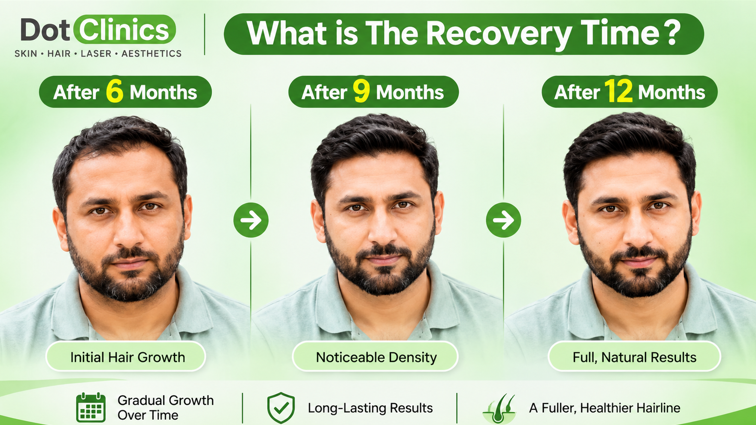
Months 3–4
New hair growth may begin appearing. The hair may initially look thin, soft, or uneven.
Months 5–9
Hair growth becomes more visible, and coverage generally starts improving.
Months 10–12
The transplanted area usually develops better density and appearance.
Months 12–18
Most results can be assessed during this period, although crown growth may mature more slowly.
Hair Transplant Before and After: What Results Can You Expect?
Before-and-after results are an important consideration when selecting a hair restoration clinic.
However, every patient has different hair characteristics and donor capacity. Therefore, outcomes vary according to several factors:
-
Number of grafts transplanted.
-
Quality of donor hair.
-
Thickness and texture of hair.
-
Size of the recipient area.
-
Graft survival.
-
Surgical technique.
-
Individual healing and growth patterns.
A successful hair transplant should provide natural-looking coverage rather than an unrealistic promise of complete restoration.
Patients should review genuine photographs of previous cases and discuss achievable outcomes with their surgeon.
How Many Hair Grafts Do You Need?
The number of grafts required depends on the area being treated, the extent of hair loss, donor hair availability, and desired density.
One graft represents a naturally occurring follicular unit that may contain one or several hair strands.
Typical planning estimates include:
| Area Being Treated | Approximate Grafts |
|---|---|
| Small frontal hairline | 500–1,200 |
| Moderate frontal area | 1,200–2,000 |
| Frontal and middle scalp | 2,000–3,000 |
| Extensive baldness | 3,000–4,500+ |
| Crown | 1,000–2,500 |
These numbers are approximate and should not be treated as fixed recommendations.
A specialist must examine the scalp before determining the number of grafts required.
What Is the Cost of a Hair Transplant?
Hair transplant cost is an important consideration for people planning surgical hair restoration.
The overall price depends on the clinic, surgeon's experience, selected technique, number of grafts, and medical facilities.
In Pakistan, hair transplantation is offered by clinics in several major cities, including Lahore, Islamabad, Karachi, and Multan.
Factors that influence the treatment price include:
Number of Grafts: A larger recipient area generally requires more grafts and additional surgical work.
Surgical Technique: FUE and FUT have different extraction and surgical requirements.
Surgeon's Expertise: The experience and qualifications of the medical professional can influence the treatment fee.
Clinic Facilities: Hygiene, equipment, surgical facilities, and trained medical staff are important considerations.
Aftercare Services: Medication, follow-up appointments, and post-operative support may be included in the treatment package.
Patients should compare treatment quality and medical standards rather than choosing a clinic based exclusively on price.
Possible Side Effects and Complications
Hair transplantation is generally safe when performed by qualified professionals. Nevertheless, patients should understand the possible side effects before undergoing surgery.
Swelling
Temporary swelling may occur around the forehead or scalp during early recovery.
Redness
The donor and recipient areas may remain red for several days or longer.
Itching
Mild itching is common during the healing process. Scratching should be avoided.
Shock Loss
Temporary shedding of transplanted hair shafts may occur during the first few weeks.
Folliculitis
Some patients develop small inflamed bumps around the hair follicles.
Infection
Infection is uncommon but may occur if proper hygiene and wound care are not maintained.
Scarring
FUE generally produces small dot-like scars, whereas FUT leaves a linear donor-area scar.
Uneven Growth
Hair growth may be uneven or less dense than expected in some patients.
Unnatural Hairline
Incorrect hairline design or poor graft placement can affect the final appearance.
Patients should seek medical advice if they develop fever, increasing pain, pus, or spreading redness.
Essential Hair Transplant Aftercare Tips
Post-operative care plays an important role in the healing process.
Patients should follow their surgeon's instructions carefully to protect the transplanted follicles.
-
Wash Your Scalp Carefully: Use the recommended cleaning method and avoid unnecessary pressure.
-
Avoid Scratching: Do not pick at scabs or rub the transplanted area.
-
Sleep in the Recommended Position: Follow instructions to avoid accidental contact with grafts.
-
Avoid Heavy Exercise: Resume strenuous activities only when approved by your surgeon.
-
Limit Direct Sun Exposure: Protect the healing scalp according to medical advice.
-
Follow Medication Instructions: Take prescribed medications as directed.
-
Attend Follow-Up Visits: Regular appointments help monitor healing and hair growth.
Is Hair Transplant a Permanent Solution for Baldness?
Hair transplantation can provide long-lasting results, but it does not completely stop the natural progression of hair loss.
The transplanted follicles generally retain their resistance to genetic hair loss. However, existing hair outside the transplanted area may continue thinning.
For this reason, some patients may benefit from additional hair loss treatments to preserve their remaining natural hair.
Options such as minoxidil and finasteride may be recommended for suitable patients after medical evaluation.
A long-term restoration strategy is particularly important for individuals who undergo surgery at a younger age.
Beard Hair Transplant: A Solution for Patchy Facial Hair
Hair transplantation can also improve beard density in individuals with naturally patchy or uneven facial hair.
The procedure generally involves extracting healthy follicles from the scalp and implanting them into selected facial areas.
Beard transplantation may be considered for:
-
Patchy beard growth.
-
Thin moustaches.
-
Uneven sideburns.
-
Facial hair loss caused by certain scars.
-
Areas with insufficient natural beard density.
The surgeon must carefully consider the angle and direction of facial hair growth to achieve a natural-looking beard.
Eyebrow Hair Transplant for Fuller Eyebrows
Eyebrow transplantation is a specialized hair restoration procedure that helps improve eyebrow density and shape.
It may be suitable for people who have experienced eyebrow thinning because of genetics, overplucking, scars, or certain injuries.
Individual hair follicles are extracted and implanted into the eyebrow region according to the desired shape and natural growth direction.
Because transplanted scalp hair may continue growing longer than natural eyebrow hair, regular trimming is often necessary.
Alternatives to Hair Transplant Surgery
Not every individual with hair loss requires surgery. Several medical and non-surgical treatments may help manage hair thinning.
Minoxidil
Minoxidil is a medication used to treat certain types of hair loss. It may improve hair growth and help maintain density with consistent use.
Finasteride
Finasteride is a prescription medication used primarily for male pattern hair loss. It reduces DHT production and may help slow further hair thinning.
It is not appropriate for everyone and may cause side effects.
PRP Hair Treatment
Platelet-Rich Plasma therapy uses a concentrated preparation of platelets obtained from the patient's blood.
The preparation is injected into the scalp to support hair growth. Results vary, and it is not a guaranteed substitute for transplantation.
Low-Level Laser Therapy
Low-level laser therapy uses specific light wavelengths to stimulate the scalp. Some patients may experience improvements in hair density.
Treatment of Medical Causes
If hair loss results from a nutritional deficiency, thyroid condition, or other medical problem, treating the underlying cause may improve hair growth.
How to Choose a Reliable Hair Transplant Clinic
Choosing a qualified clinic is essential for achieving satisfactory results and reducing surgical risks.
Before selecting a facility, consider these important points:
-
Verify the surgeon's medical qualifications and relevant training.
-
Ask about experience with FUE and FUT procedures.
-
Review genuine before-and-after patient photographs.
-
Check the clinic's hygiene and infection-control standards.
-
Request transparent information about graft numbers and treatment costs.
-
Discuss realistic expectations and possible complications.
-
Confirm that appropriate follow-up care is available.
-
Ask which stages of the surgery will be performed by the surgeon and which will be performed by other team members.
A trustworthy clinic should provide an individualized treatment plan instead of making unrealistic promises about guaranteed density or permanent results.
Hair Transplant in Pakistan: What Patients Should Know
Hair transplantation is available in several major Pakistani cities, including Lahore, Islamabad, Karachi, and Multan.
Patients can find clinics offering FUE, FUT, and other hair restoration services according to their medical needs and treatment preferences.
When selecting a hair transplant clinic in Pakistan, patients should prioritize medical qualifications, surgical experience, hygiene standards, transparent pricing, and proper aftercare.
It is also important to understand that a low-cost procedure does not necessarily represent good value. The quality of surgical planning, graft handling, and implantation can significantly influence the final outcome.
A professional consultation is the best way to determine whether hair transplantation is appropriate for your condition.
Frequently Asked Questions About Hair Transplant
1. What is the success rate of a hair transplant?
Success depends on patient selection, donor hair quality, surgical technique, graft handling, and post-operative care. Results vary, so no universal success rate applies to every patient.
2. How many hours does hair transplant surgery take?
Most procedures take approximately 4–10 hours, depending on the number of grafts and the complexity of the treatment.
3. Is hair transplantation painful?
Local anaesthesia helps minimize discomfort during surgery. Mild pain or tenderness may occur during recovery.
4. How long does it take for transplanted hair to grow?
New growth commonly begins around three to four months after surgery, with more noticeable results developing over the following months.
5. Will transplanted hair look natural?
Yes, when the procedure is properly planned and performed, transplanted hair can look natural. Hairline design and graft placement are especially important.
6. Can I undergo a hair transplant if I am completely bald?
Some individuals with extensive baldness may still qualify if sufficient donor hair is available. However, the achievable coverage and density may be limited.
7. Can hair transplantation be performed without shaving?
Some FUE approaches can be performed with partial or no shaving in selected patients. Availability depends on the surgeon and treatment requirements.
8. Is FUE better than FUT?
Both techniques have advantages. FUE avoids a linear scar, while FUT can be useful for harvesting a large number of grafts. The best choice depends on individual needs.
9. Can transplanted hair become grey?
Yes. Transplanted hair can turn grey naturally as the patient ages.
10. Does hair transplantation require repeated sessions?
Many patients achieve their desired coverage in one session, while others may need additional procedures depending on their hair loss and available donor supply.
11. Can women receive hair transplants?
Yes. Women with suitable hair loss patterns and sufficient donor hair may benefit from transplantation.
12. Can I use shampoo after a hair transplant?
Patients can usually resume gentle scalp washing according to their surgeon's instructions. The timing and washing technique should be individualized.
13. When can I return to exercise?
Light activities may resume relatively soon, but strenuous exercise should be avoided until the surgeon confirms it is safe.
14. Does a hair transplant stop future hair loss?
No. It relocates healthy follicles but does not prevent existing non-transplanted hair from thinning.
15. How long do hair transplant results last?
Transplanted follicles can continue producing hair for many years. However, ageing and ongoing hair loss may change the overall appearance over time.
Conclusion: Is Hair Transplant the Right Choice for You?
Hair transplantation has transformed the way permanent hair loss is managed. With established techniques such as FUE and FUT, individuals can restore hair coverage, improve their hairline, and achieve natural-looking results.
However, successful hair restoration requires more than selecting a popular procedure. Proper diagnosis, donor area evaluation, realistic treatment planning, experienced surgical care, and consistent aftercare all contribute to the outcome.
Before undergoing a hair transplant, consult a qualified specialist who can assess your condition and explain the most appropriate treatment options.
With suitable patient selection and professional medical guidance, hair transplantation can be a valuable long-term solution for individuals looking to address permanent hair loss.
Medical Disclaimer: This article is intended for general educational purposes and does not replace professional medical advice, diagnosis, or treatment. Always consult a qualified healthcare professional before undergoing hair transplantation or starting hair loss medication.

 Arabic
 French
 Spanish
 Portuguese
 Deutsch
 Turkish
 Dutch
 Italiano
 Russian
 Romaian
 Portuguese (Brazil)
 Greek