


Sponge Counting System Market Growth as Hospitals Adopt Digital Tracking
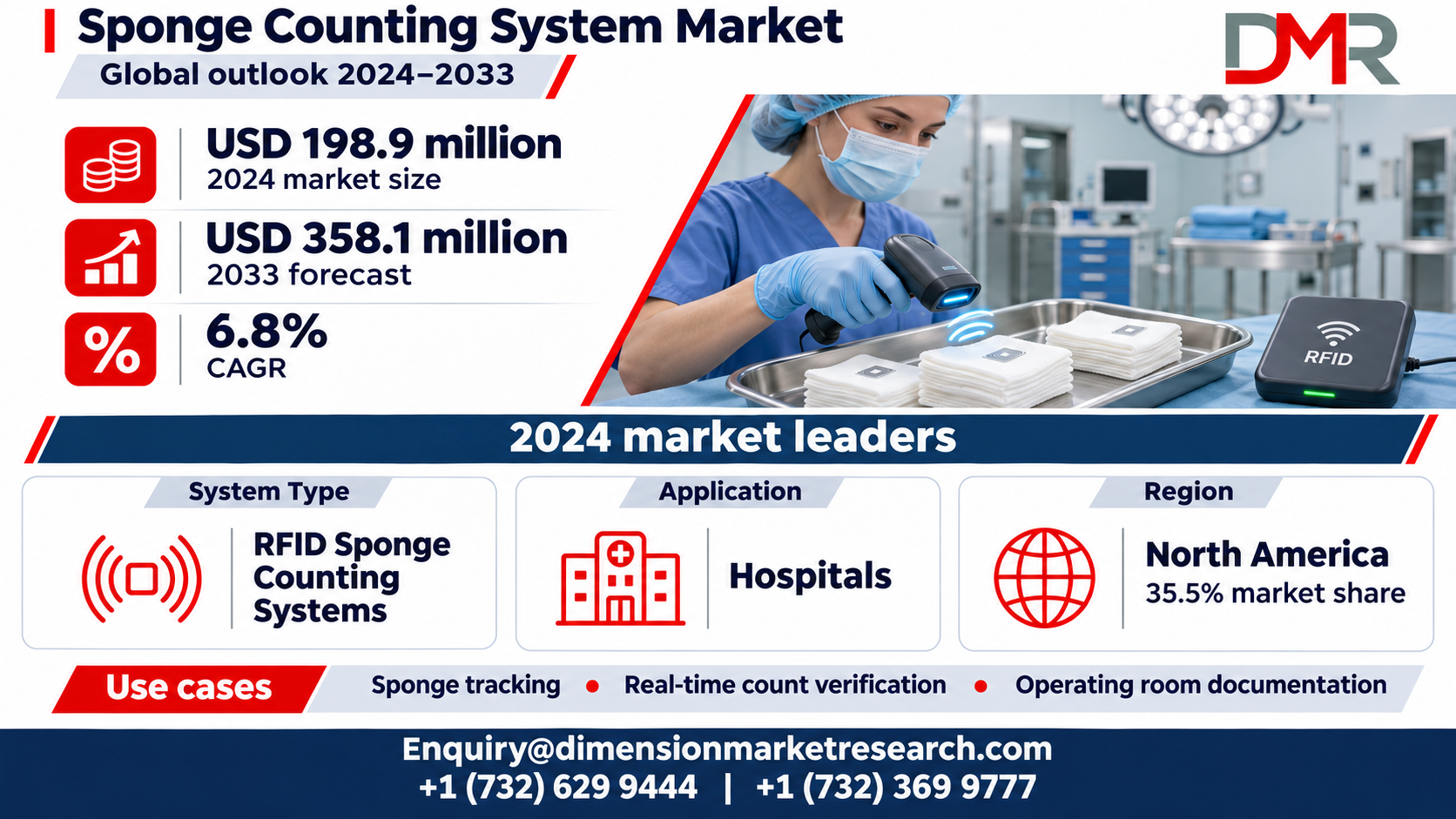
A surgical sponge count involves accounting for items that enter and leave the operating field. When the numbers differ, staff must reconcile the count. Radio-frequency identification (RFID) and barcode systems give teams a digital way to identify or record sponges during that process. Their adoption is shaping Sponge Counting System Market Growth as hospitals look for better ways to track surgical supplies and document counts.
According to Dimension Market Research, the global market was estimated at USD 198.9 million in 2024 and is projected to reach USD 358.1 million by 2033, at a reported CAGR of 6.8%. The push to reduce the risk of retained surgical items and the adoption of digital tracking in operating rooms are central to the outlook.
What Is the Sponge Counting System Market?
The market covers systems that help surgical teams track and account for sponges used during procedures. The report divides the market into RFID and barcode sponge counting systems and assesses demand across hospitals, clinics, and other settings. Both technologies identify compatible sponges, but they collect that information differently.
An RFID system reads a tag embedded in a compatible sponge without requiring a visible code. A barcode system relies on staff presenting each code to a scanner. That difference affects how teams document counts, how much equipment a facility needs, and how the system fits into existing operating room routines.
Get a Free Customized Sample of This or Any Other Market Research Report
https://dimensionmarketresearch.com/request-sample/sponge-counting-system-market/
Why RFID Leads and Where Barcodes Fit
The report identifies RFID as the leading system type in its 2024 estimates. Its advantage is the ability to detect compatible tagged sponges without a direct line of sight. Barcode systems offer a lower-cost route to digital counting, although each sponge must be scanned individually. The purchasing decision therefore depends on how a facility balances cost, workflow, and the level of automation it needs.
● RFID sponge tracking uses embedded tags and a reader to help staff identify and account for compatible sponges.
● Barcode sponge counting records individual items as staff scan them into and out of the surgical workflow.
● Hospital adoption is supported by the need to manage counts across a range of procedures and operating rooms.
The report cites an April 2023 example at the Kerala Institute of Medical Sciences. The institution implemented a system that assigned barcodes to surgical sponges before sterilization and recorded scans during surgery. The example shows how digital tracking can start before a sponge reaches the operating room.
What Drives Adoption in Hospitals?
Hospitals lead the application segment. The report links their position to surgical activity and a focus on reducing the risk of retained surgical items. A digital record can help staff review which sponges were scanned and investigate discrepancies. In a high-volume facility, the value also depends on whether staff can follow the same process consistently across operating rooms and shifts.
Cost remains a barrier, particularly for smaller facilities. For buyers, a comparison involves more than the upfront price of a reader or scanner. Compatible sponge supplies, staff training, and the work needed to integrate counting into existing routines can affect the total cost. A clinic with fewer procedures may reach a different purchasing decision than a hospital adopting the technology across several operating rooms.
North America Leads the Regional Market
North America was projected to account for 35.5% of global revenue in 2024. The report attributes its position to established healthcare infrastructure and a strong focus on surgical safety. Within the region, the U.S. market was estimated at USD 59.4 million in 2024 and is forecast to reach USD 103.7 million by 2033, at a reported CAGR of 6.4%.
The competitive landscape includes Cardinal Health, STERIS Healthcare, Stryker, Medtronic, Medline, and Tally Surgical. As facilities assess digital counting options, suppliers can differentiate on how consistently their equipment and compatible consumables fit the day-to-day work of surgical teams.
Explore the Complete Sponge Counting System Market Analysis
https://dimensionmarketresearch.com/checkout/sponge-counting-system-market/
FAQs
How large is the Sponge Counting System Market?
The global market was estimated at USD 198.9 million in 2024 and is projected to reach USD 358.1 million by 2033.
What is the projected market growth rate?
The report lists a 6.8% CAGR for the 2024 to 2033 forecast period.
Which sponge counting technology leads the market?
RFID was projected to hold the largest revenue share by system type in 2024.
Which region leads the Sponge Counting System Market?
North America was projected to lead with 35.5% of global revenue in 2024.
How does barcode sponge counting work?
Staff scan codes on compatible sponges individually to record them as they enter and leave the surgical workflow.
Conclusion
Through 2033, growth is expected to come from facilities adding digital tracking to their surgical count processes. RFID offers a way to read tagged sponges without line-of-sight scanning, while barcodes give facilities a lower-cost path to recording individual items. How easily either system fits into the operating room routine will influence where it gains adoption.
Related Surgical Market Insights
The Laparotomy Sponge Market Size is projected to rise from USD 1,899.5 million in 2025 to USD 3,273.1 million by 2034. The report links demand to surgical procedure volumes and interest in detectable sponges.
The Americas Surgical Equipment Market Share report identifies surgical instruments as the leading product type, with a projected 38.6% share in 2026. The regional market is forecast to reach USD 46.8 billion by 2035.
The Surgical Sutures Market Growth forecast projects an increase from USD 4.9 billion in 2023 to USD 7.5 billion by 2032, at a reported CAGR of 4.8%.

 English
 Arabic
 French
 Spanish
 Portuguese
 Deutsch
 Turkish
 Dutch
 Russian
 Romaian
 Portuguese (Brazil)
 Greek