


Industrial Lubricants Market Growth Through 2035: Synthetics, Automation and Power
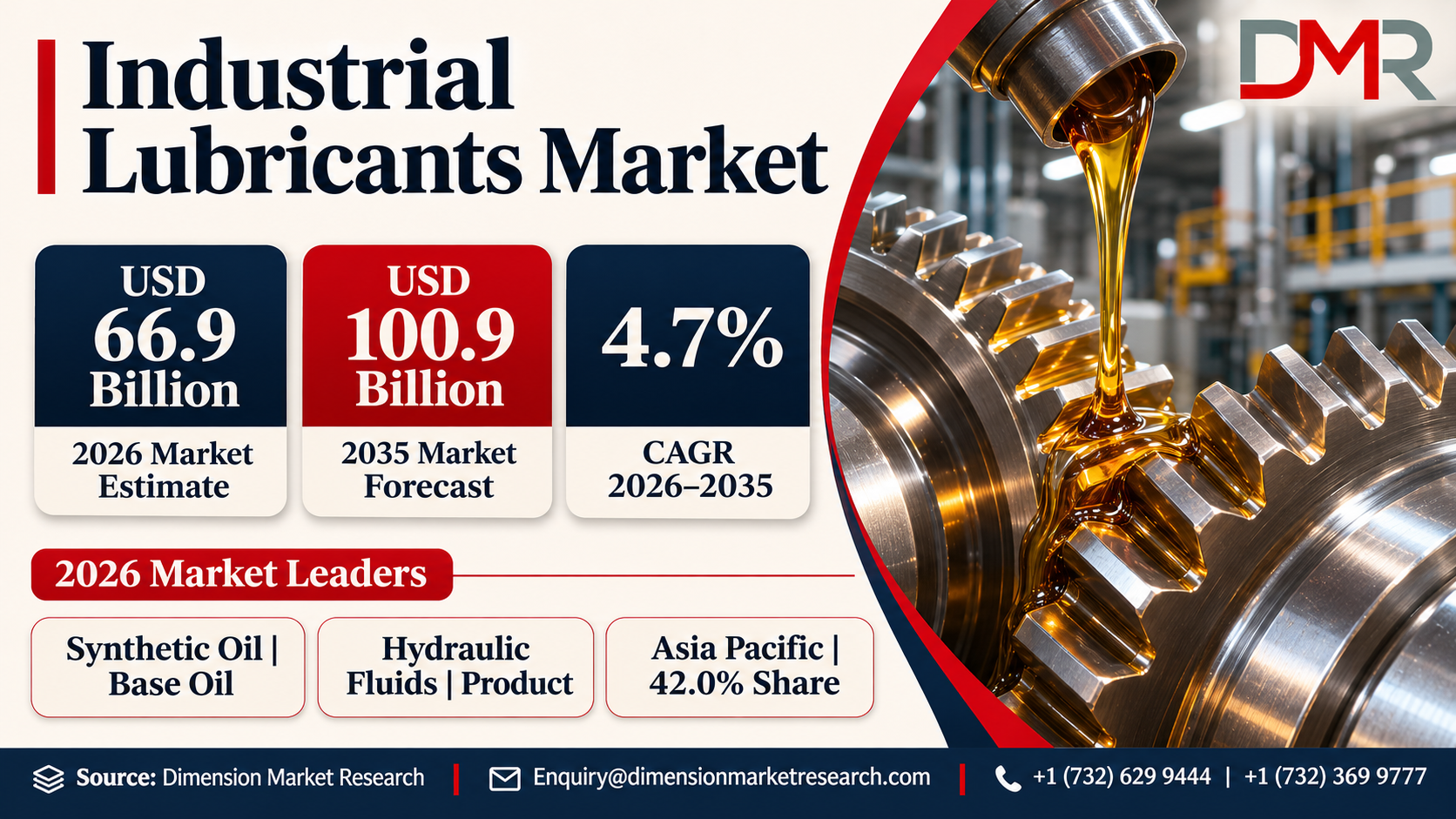
The Industrial Lubricants Market Growth outlook reflects rising demand for equipment reliability and energy efficiency across manufacturing, construction and power generation. According to Dimension Market Research, the global market is estimated at USD 66.9 billion in 2026 and projected to reach USD 100.9 billion by 2035, at a CAGR of 4.7% from 2026 to 2035.
Automation and renewable energy investment are shaping demand in different ways. Automated production lines place a premium on predictable maintenance, while turbines and other power equipment require lubricants suited to their operating conditions. For industrial buyers, these trends make lubricant selection a maintenance and procurement decision, with implications for service intervals, equipment availability and operating costs.
What Is the Industrial Lubricants Market?
Industrial lubricants are oils, greases and fluids used to manage friction, heat and wear in machinery. Formulations typically combine a mineral, synthetic or bio-based oil with additives tailored to the application. The market covers hydraulic fluids, gear oils, greases, metalworking fluids, turbine oils and transformer oils, among other products.
Each product serves a different purpose. Hydraulic fluid transmits power in equipment such as presses and excavators. Metalworking fluids help cool and lubricate cutting, grinding and forming operations, where tool life and surface finish matter. An industrial plant may therefore buy several lubricant types through the same procurement program, with separate performance requirements for each application.
Get a Free Customized Sample of This or Any Other Market Research Report
https://dimensionmarketresearch.com/request-sample/industrial-lubricants-market/
Synthetic Oil, Hydraulic Fluids and Automotive Lead Their Segments
DMR’s 2026 estimates highlight where demand is concentrated across base oils, products and end users. The hydraulic fluid figure is measured by volume.
● Synthetic oil leads by base oil, with approximately 46% share. Its stability under heat and resistance to oxidation can support longer intervals between oil changes in demanding applications.
● Hydraulic fluids lead by product, with around 28% volume share. Construction equipment, manufacturing machinery and other heavy equipment account for much of this demand.
● Automotive leads by end user, with an estimated 24% market share. The report links its position to lubricant use in vehicle production, assembly and equipment maintenance.
DMR identifies bio-based oils as the fastest-growing base oil category and power generation as the fastest-growing end-user segment. The two growth areas reflect different purchasing priorities. Interest in bio-based oils is tied to environmental requirements and biodegradability. Demand in power generation is linked to renewable energy projects, grid investment and the performance requirements of turbines and other equipment.
Asia Pacific Market Share and Middle East & Africa Growth Outlook
Asia Pacific is projected to lead the global Industrial Lubricants Market with a 42.0% share in 2026. DMR highlights manufacturing and infrastructure development in China and India, with automotive production, metal production and construction contributing to regional demand. For suppliers, the region’s industrial mix creates opportunities across both high-volume hydraulic fluids and specialized products for production equipment.
The Middle East & Africa is projected to grow fastest, supported by investment in oil and gas, construction, power and industrial zones. DMR also estimates the US market at USD 14.0 billion in 2026, with a 4.4% CAGR over the forecast period, and the European market at USD 16.7 billion in 2026, with a 4.3% CAGR. The report highlights automation and manufacturing modernization in the US and demand for biodegradable formulations in Europe.
Condition Monitoring Changes How Buyers Evaluate Lubricants
Sensors and connected monitoring systems can help maintenance teams track lubricant condition and schedule service before deterioration causes disruption. In a plant with several production lines, that can make it easier to identify which assets need attention first. It also gives buyers a way to assess whether longer service intervals are practical for a particular machine and operating environment.
Higher lubricant costs and environmental requirements can slow adoption. A purchasing team evaluating a premium synthetic can compare its price with the potential savings from fewer oil changes, less maintenance labor and shorter shutdowns. For bio-based formulations, the assessment also includes suitability for the intended equipment and the applicable handling and disposal requirements.
Industrial Lubricant Suppliers and Competitive Landscape
The report profiles companies including Royal Dutch Shell, Exxon Mobil Corporation, TotalEnergies, FUCHS Petrolub SE, Indian Oil Corporation and ENEOS Corporation. Product development, distribution networks and relationships with industrial customers are important competitive factors. For suppliers, reliable local availability and technical support can complement formulation performance, particularly when customers need the same grade across multiple sites or want support evaluating a change in lubricant.
Explore the Complete Industrial Lubricants Market Analysis
https://dimensionmarketresearch.com/checkout/industrial-lubricants-market/
Frequently Asked Questions
How large is the Industrial Lubricants Market?
DMR estimates USD 66.9 billion in 2026 and projects USD 100.9 billion by 2035.
What is the Industrial Lubricants Market growth rate?
The market is projected to grow at a CAGR of 4.7% from 2026 to 2035.
Which region leads the Industrial Lubricants Market?
Asia Pacific leads with an estimated 42.0% share in 2026.
Which base oil leads the Industrial Lubricants Market?
Synthetic oil leads the base oil segment with approximately 46% share in 2026.
What is driving Industrial Lubricants Market growth?
Industrial automation, demand for energy efficiency and adoption of synthetic lubricants support market growth.
Conclusion
The Industrial Lubricants Market outlook combines established demand from automotive manufacturing and heavy equipment with growth in power generation and bio-based oils. For suppliers and procurement teams, the commercial opportunity depends on matching the formulation to the equipment, the operating conditions and the maintenance economics of each application.

 English
 Arabic
 French
 Spanish
 Portuguese
 Deutsch
 Turkish
 Dutch
 Italiano
 Romaian
 Portuguese (Brazil)
 Greek