


Why LLM in UK Consider as the Best Law Course?
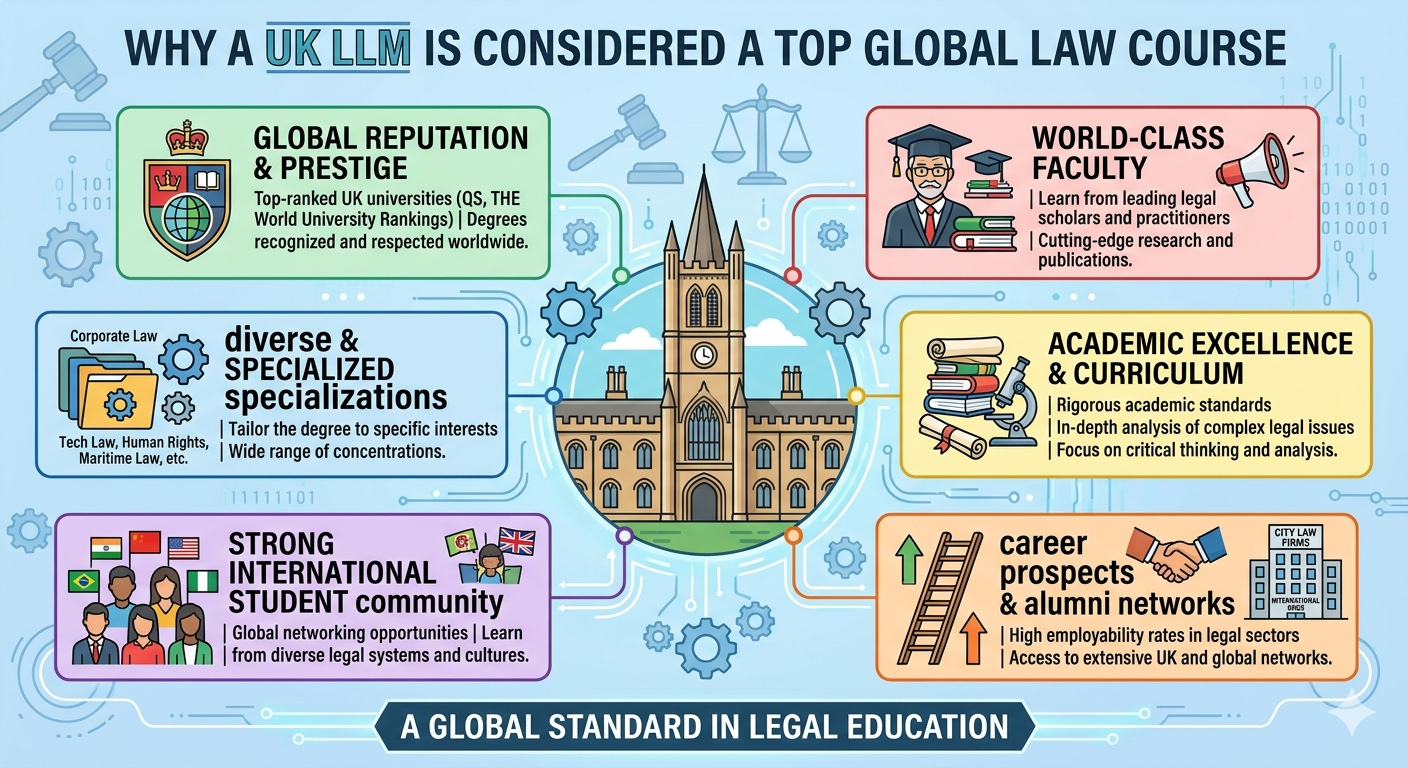
If you’re standing at that crossroads where legal ambition meets academic reality, you’ve probably heard the same thing over and over from peers, professors, and professionals: go to the UK for your Master of Laws. Not just anywhere. The UK. After years of placing students into law programs worldwide, we can tell you this isn’t just reputation or nostalgia for oak-panelled libraries. There’s a structural, almost mechanical reason why the LLM in the UK continues to outperform other destinations.
Let’s unpack that, fact by fact.
A Legal System That Actually Travels
Here’s something most ranking tables won’t spell out: the common law system, which governs everything from international contracts to maritime disputes to fintech regulations, was born in England. When you study LLM in UK, you’re not learning a local variant of law—you’re learning the original framework that half the world’s legal systems copied, adapted, or argued against.
For an international student, this is pure leverage. Whether you return to Mumbai, Lagos, Kuala Lumpur, or New York, the legal logic you master in a UK classroom is the same logic your future opposing counsel or corporate client uses. That’s not true for civil law systems. It’s not even true for most other common law countries, where local statutes override transnational principles. The UK keeps it clean. They teach law as structure, not as local trivia.
One Year, Maximum Compression
Let’s talk about time, because time is money, and you know that better than most.
Most LLM programs globally stretch to two years. The UK compresses the same often more rigorouscontent into twelve months. You start in September. By the next summer, you’re holding a degree and applying for roles. That single year difference matters enormously when you’re calculating opportunity cost. Two years out of the job market versus one? For a lawyer, that’s not just math. That’s career strategy.
We’ve seen students finish their UK LLM, complete the necessary conversions or bar exams back home, and enter practice while their peers in longer programs are still writing term papers. The intensity is real. But so is the payoff.
The 2026 Window: What’s Changing
Now, let’s look forward because you’re not reading this for historical trivia. The best law courses in UK 2026 are already shaping up differently than previous years.
Universities are quietly retiring generalist LLMs. What’s replacing them? Hyper-specialized tracks: AI and data ethics, climate transition law, cross-border insolvency, and sports arbitration. Why? Because UK law schools have always been unusually responsive to what City law firms actually need. And right now, those firms are desperate for lawyers who can handle novel legal terrain—not just contract disputes from 1992.
By 2026, expect most Russell Group LLMs to require a declared specialism by the end of your first semester. That’s not a drawback. That’s a feature. It means your dissertation, your network, and your placement opportunities all align with one coherent professional identity. Employers love that clarity.
The “Hidden” Advantage: Dissertation as Work Sample
American LLMs tend to focus on coursework and exams. European programs lean theoretical. The UK LLM sits in a useful middle ground: heavy on seminars, light on lectures, and utterly dependent on your dissertation.
That dissertation 12,000 to 15,000 words is not just an academic exercise. It’s the single most effective job interview tool we’ve ever seen. Students who treat it as a research project miss the point. Students who treat it as a publishable white paper on a live legal problem get offers. Because partners read those. They genuinely do. A tight analysis of a regulatory gap, written with real legal craftsmanship, is more persuasive than any cover letter.
We’ve had students email their dissertation to a firm’s practice group leader and receive a call within a week. That happens in the UK. It almost never happens elsewhere.
Where the Best Law Courses in UK 2026 Actually Are
You’ll see lists. Top 10. World rankings. They’re useful but noisy. Let’s give you a cleaner signal.
For international arbitration and energy law: Queen Mary, Aberdeen, Dundee. Not Oxford. Not Cambridge. Those are fine, but for practical placement records in arbitration, these three outperform consistently.
For human rights and public law: LSE and UCL remain dominant, but Essex has a sleeper program that places disproportionately into the UN and ICC systems.
For commercial and corporate law: LSE, King’s College London, Warwick. Warwick in particular runs a smaller cohort, which means your supervisor actually knows your name—rare in an LLM year of 200+ students.
For tech and IP law: Edinburgh and Bristol. Edinburgh’s AI regulation module is currently being written by the same academics advising the Scottish government. That’s live policy work.
Don’t chase the brand. Chase the module list and the placement record for your specific legal interest.
The Cost Question Nobody Answers Properly
Yes, the UK is expensive. Tuition for top LLMs ranges from £22,000 to £45,000. Living costs in London will hurt. That’s the surface truth.
But here’s the deeper truth we’ve observed after a decade of advising: UK LLM graduates recoup that cost faster than almost any other master’s degree. Why? Because the degree is one year, so you’re back earning sooner. Because UK law firms sponsor visas more readily than US firms for specialized roles. Because the alumni networks in London, Singapore, Dubai, and Hong Kong are unusually tight—they hire their own.
We’ve run the numbers with returning students. Break-even point for a UK LLM, if you enter commercial practice: 18 to 30 months. For a two-year program elsewhere: 36 to 48 months. That difference matters.
The Visa Reality (Not Fearmongering)
The Graduate Route visa remains in place as of 2026 planning. That gives you two years post-LLM to work, find sponsorship, or transition. It’s not permanent residency. It’s not a guarantee. But it is a genuine professional runway—longer than the US’s OPT, shorter than Canada’s open work permit, but more legally coherent for lawyers specifically.
If your goal is to qualify as a solicitor in England and Wales via the SQE, the LLM buys you time to prepare for those exams while holding a visa. That’s a concrete path, not a hypothetical.
Final Practical Note
We don’t tell students to study LLM in UK because it’s prestigious. We tell them because the structure compressed, specialized, dissertation-driven, and connected to a living common law tradition matches how legal careers actually advance. Not in theory. In practice.
The best law courses in UK 2026 will not be the ones with the prettiest brochures. They’ll be the ones whose graduates, two years later, are billing hours in practices that didn’t exist five years ago. That’s the real metric. Everything else is marketing.If you’re ready for that pace, that specificity, and that return start your shortlist now. The application cycle for 2026 opens sooner than you think.

 Arabic
 French
 Spanish
 Portuguese
 Deutsch
 Turkish
 Dutch
Dutch
 Italiano
 Russian
 Romaian
 Portuguese (Brazil)
 Greek
Greek