


How Does an 18 Wheeler Accident Lawyer Texas Prove FMCSA Violations?
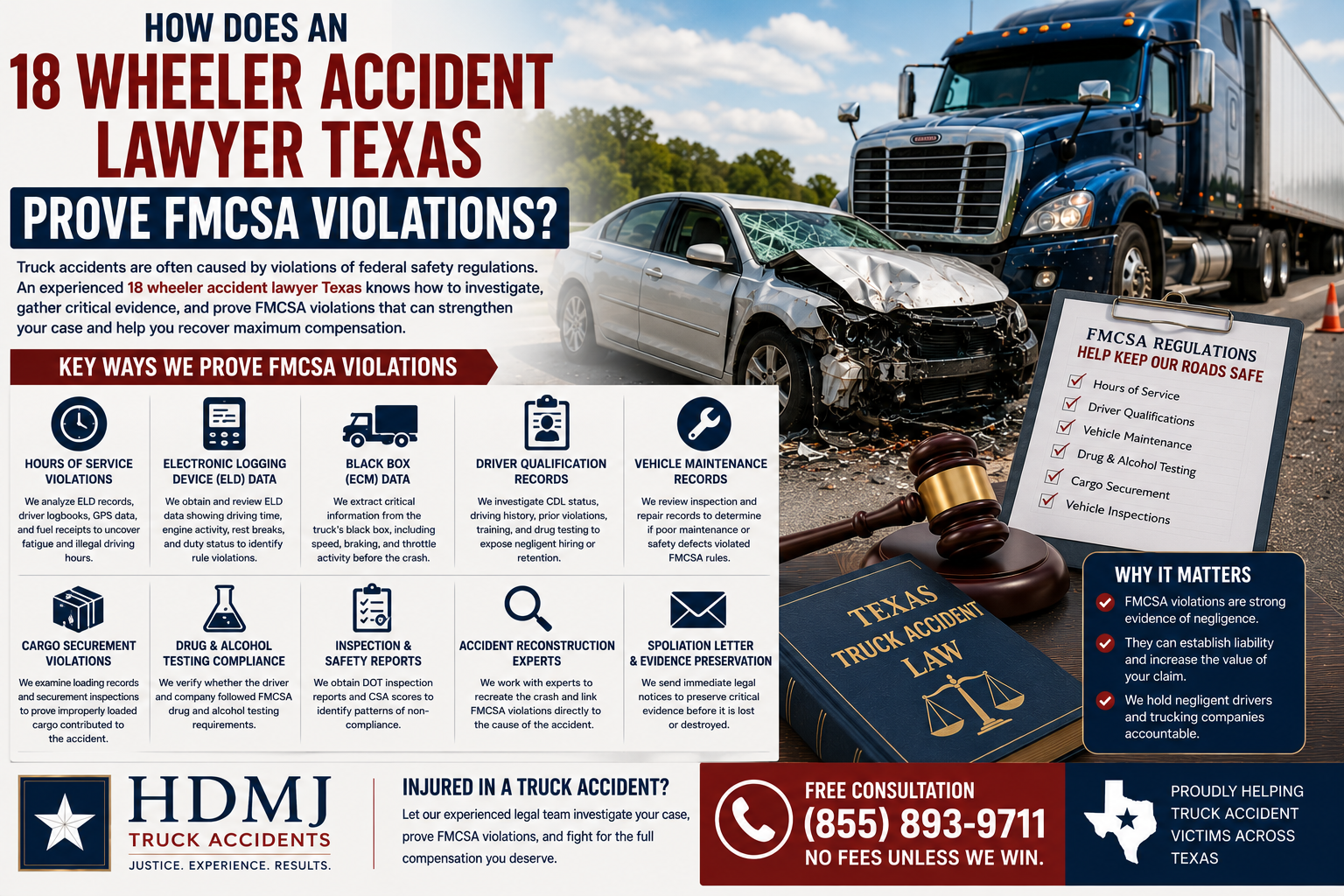
A collision involving an 18-wheeler can leave victims with catastrophic injuries, overwhelming medical expenses, and uncertainty about what comes next. Unlike standard car accident claims, truck accident cases often involve federal safety regulations that govern nearly every aspect of the commercial trucking industry. When these regulations are violated, they may provide powerful evidence of negligence. Working with an experienced Texas truck accident lawyer can help uncover these violations and build a stronger case for compensation.
An experienced 18 wheeler accident lawyer Texas understands how to investigate trucking companies, obtain critical records, and determine whether violations of the Federal Motor Carrier Safety Administration (FMCSA) regulations contributed to the accident.
What Is the FMCSA?
The Federal Motor Carrier Safety Administration (FMCSA) is a federal agency responsible for improving safety within the commercial trucking industry.
The FMCSA establishes rules governing:
-
Driver qualifications
-
Hours of Service (HOS)
-
Vehicle inspections
-
Truck maintenance
-
Drug and alcohol testing
-
Cargo securement
-
Electronic Logging Devices (ELDs)
-
Commercial Driver's Licenses (CDLs)
These regulations are designed to reduce crashes and improve roadway safety throughout the United States.
Why FMCSA Violations Matter in Truck Accident Cases
When a trucking company or driver fails to comply with FMCSA regulations, those violations may indicate negligence.
Examples include:
-
Driving beyond legal hour limits
-
Operating an improperly maintained truck
-
Hiring an unqualified driver
-
Failing required inspections
-
Ignoring safety defects
-
Improperly securing cargo
Although an FMCSA violation does not automatically establish liability, it can serve as valuable evidence when combined with other facts surrounding the accident.
Investigating Hours of Service Violations
Driver fatigue remains one of the leading causes of commercial truck accidents.
FMCSA Hours of Service (HOS) rules limit how long commercial drivers may operate without adequate rest.
An attorney reviews:
-
Electronic Logging Device (ELD) records
-
Driver logbooks
-
Dispatch records
-
Fuel receipts
-
GPS tracking data
-
Toll records
Comparing these records may reveal inconsistencies indicating the driver exceeded allowable driving hours.
Reviewing Electronic Logging Device Records
Most commercial trucks are equipped with Electronic Logging Devices (ELDs) that automatically record driving activity.
These records can show:
-
Driving time
-
Rest periods
-
Engine operation
-
Vehicle movement
-
Duty status
ELD data often provides objective evidence that helps determine whether federal regulations were followed before the crash.
Examining Black Box Data
Commercial trucks often contain an Electronic Control Module (ECM), commonly called the truck's black box.
This system may record:
-
Vehicle speed
-
Brake application
-
Engine performance
-
Steering input
-
Cruise control use
-
Sudden deceleration
Black box evidence can help determine whether the driver attempted to avoid the collision or whether mechanical issues contributed to the crash.
Because electronic data can eventually be overwritten, attorneys work quickly to preserve it.
Investigating Driver Qualification Files
FMCSA regulations require trucking companies to maintain qualification records for commercial drivers.
A lawyer may review:
-
Commercial Driver's License (CDL)
-
Employment history
-
Driving record
-
Previous crashes
-
Medical certifications
-
Drug and alcohol testing
-
Safety training
If the trucking company hired or retained an unqualified driver, it may share responsibility for the accident.
Reviewing Vehicle Maintenance Records
Commercial trucks require routine inspections and maintenance to remain safe.
Attorneys often request documentation involving:
-
Brake inspections
-
Tire replacements
-
Steering repairs
-
Engine maintenance
-
Annual inspections
-
Repair histories
Poor maintenance or ignored safety defects may violate FMCSA regulations and contribute directly to an accident.
Investigating Cargo Securement Violations
Improperly secured cargo can make an 18-wheeler unstable, increasing the risk of rollovers, jackknife accidents, or cargo spills.
Evidence may include:
-
Bills of lading
-
Cargo weight records
-
Loading instructions
-
Securement inspection reports
If improper cargo loading contributed to the collision, the cargo loading company may also bear responsibility.
Examining Drug and Alcohol Testing Compliance
FMCSA regulations require commercial drivers to undergo drug and alcohol testing in certain situations.
An attorney investigates whether the trucking company properly followed testing requirements, including:
-
Pre-employment testing
-
Random testing
-
Post-accident testing
-
Reasonable suspicion testing
Failure to comply with these requirements may strengthen evidence of negligence.
Working With Accident Reconstruction Experts
Complex truck accident cases often require expert analysis.
Accident reconstruction specialists evaluate:
-
Vehicle damage
-
Tire marks
-
Road conditions
-
Black box data
-
Vehicle speeds
-
Crash dynamics
Their findings can help connect FMCSA violations to the cause of the accident.
Sending a Spoliation Letter
One of the first steps after accepting a truck accident case is often sending a spoliation letter.
This legal notice instructs the trucking company to preserve evidence such as:
-
Black box data
-
ELD records
-
Driver qualification files
-
Maintenance records
-
Inspection reports
-
GPS records
-
Dashcam footage
Without prompt legal action, some electronic records may be deleted or overwritten through normal business operations.
Why Early Legal Representation Matters
The trucking company and its insurance carrier often begin investigating immediately after a serious accident.
By hiring an experienced attorney early, you improve your ability to:
-
Preserve electronic evidence
-
Obtain trucking records
-
Interview witnesses
-
Investigate FMCSA violations
-
Identify all liable parties
-
Build a stronger compensation claim
Waiting too long may result in lost evidence that cannot be recovered later.
Conclusion
FMCSA regulations play an important role in many commercial truck accident claims. Violations involving driver fatigue, maintenance, inspections, cargo securement, or driver qualifications can provide strong evidence of negligence when properly investigated.
An experienced 18 wheeler accident lawyer Texas understands how to obtain black box data, Electronic Logging Device records, maintenance documents, and other critical evidence needed to prove these violations. If you or a loved one has been injured in a commercial truck accident, early legal action can help preserve valuable evidence and strengthen your pursuit of fair compensation.
Frequently Asked Questions
1. What are FMCSA regulations?
FMCSA regulations are federal safety rules governing commercial truck drivers, trucking companies, vehicle maintenance, inspections, cargo securement, and Hours of Service requirements.
2. How can FMCSA violations affect a truck accident claim?
Violations may serve as evidence that a trucking company or driver failed to follow required safety standards, helping establish negligence in certain cases.
3. What records help prove FMCSA violations?
Important records include Electronic Logging Device (ELD) data, black box information, maintenance records, driver qualification files, inspection reports, and drug testing records.
4. Why should evidence be preserved quickly after a truck accident?
Electronic records, surveillance footage, and other important evidence may be deleted or overwritten if they are not preserved promptly.
5. Can a trucking company be liable for FMCSA violations?
Yes. If the company failed to hire qualified drivers, maintain vehicles, enforce safety policies, or comply with federal regulations, it may share responsibility for the accident.

 English
 Arabic
 French
 Spanish
 Portuguese
 Deutsch
 Turkish
 Dutch
Dutch
 Italiano
 Romaian
 Portuguese (Brazil)
 Greek
Greek