


Trade Credit Insurance Underwriting
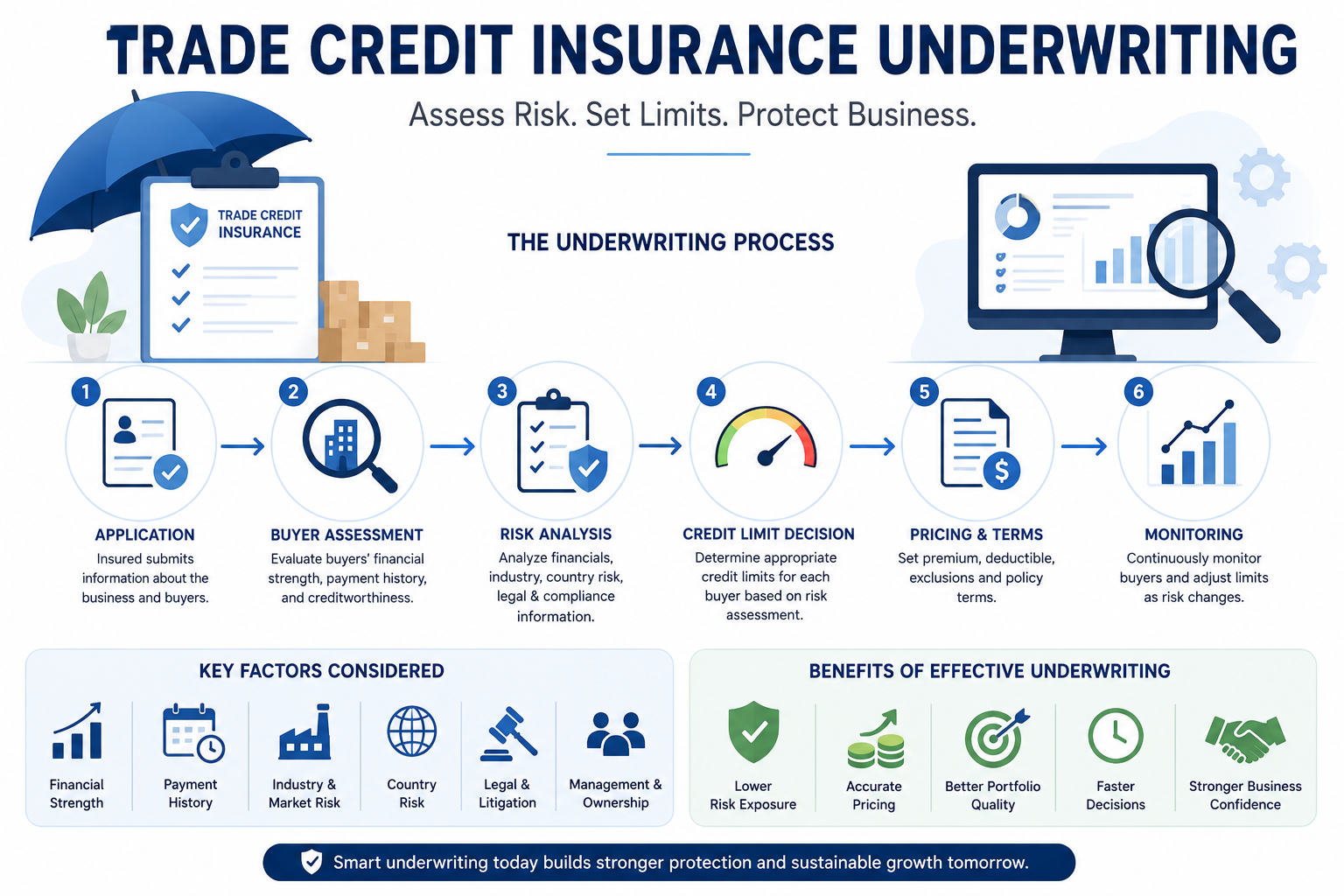
Businesses often sell goods and services to customers on credit, giving buyers time to make payments after receiving products or completing a transaction. While credit sales can support business growth, they also create the risk of delayed or unpaid invoices. Trade credit insurance helps businesses protect against certain losses arising from customer non-payment.
At the center of this process is trade credit insurance underwriting. It involves evaluating the financial strength, payment behavior, business profile, industry conditions, and creditworthiness of buyers before an insurer determines whether and on what terms to provide coverage.
For insurers, lenders, banks, NBFCs, fintech companies, and enterprises, effective underwriting can improve credit risk assessment, pricing, portfolio management, and overall financial decision-making.
Table of Contents
- What Is Trade Credit Insurance Underwriting?
- Why Is Trade Credit Insurance Underwriting Important?
- Key Factors Considered in Underwriting
- Trade Credit Insurance Underwriting Process
- Role of Technology and Risk Intelligence
- Benefits of Effective Underwriting
- Best Practices for Insurers
- FAQs
- Conclusion
What Is Trade Credit Insurance Underwriting?
Trade credit insurance underwriting is the process of assessing the risk associated with insuring a business against losses caused by a customer's failure to pay trade debts.
An insurer typically evaluates both the policyholder and the buyers whose receivables are being insured. The objective is to determine the probability of non-payment and establish suitable coverage limits, premiums, exclusions, and policy conditions.
Depending on the policy and insurer, underwriting may consider:
- Buyer financial strength
- Payment history
- Outstanding receivables
- Credit exposure
- Business and ownership information
- Industry conditions
- Geographic and country risk
- Legal and regulatory developments
- Existing debt obligations
- Historical claims
- Concentration of customers
For example, an exporter selling products to several overseas buyers may seek trade credit insurance to protect its receivables. The insurer would assess the buyers' financial health, payment behavior, industry outlook, and country-specific risks before determining appropriate coverage.
Why Is Trade Credit Insurance Underwriting Important?
Protects Against Uncertain Credit Risk
A customer's financial condition can change after a credit sale is made. Effective underwriting helps insurers understand the likelihood of non-payment before accepting the risk.
Supports Accurate Pricing
Riskier buyers may require higher premiums or lower credit limits, while financially stronger buyers may qualify for more favorable terms. Better risk assessment supports more appropriate pricing.
Improves Portfolio Management
Insurers may have exposure to thousands of businesses and buyers. A structured underwriting process helps manage concentration risk and maintain a balanced insurance portfolio.
Supports Business Growth
Trade credit insurance can give businesses greater confidence when extending credit to new or existing customers. This can support sales growth while reducing the financial impact of certain customer defaults.
Key Factors Considered in Underwriting
Financial Strength of the Buyer
Financial statements can provide insight into revenue, profitability, liquidity, leverage, cash flow, and debt obligations.
A company with weakening profitability, increasing debt, and limited liquidity may present a higher credit risk than a financially stable buyer.
Payment Behavior
Historical payment patterns are important indicators of credit risk. Repeated late payments or increasing overdue receivables may require additional investigation.
Industry Risk
Economic conditions affect industries differently. An insurer may consider demand fluctuations, commodity prices, regulatory changes, competition, and other sector-specific risks.
Business and Ownership Information
Understanding the company's legal structure, directors, promoters, ownership, and business history can provide additional context for underwriting decisions.
Legal and Compliance Risk
Litigation, regulatory actions, insolvency proceedings, and significant compliance concerns may affect the buyer's ability or willingness to meet financial obligations.
Customer Concentration
A business heavily dependent on a small number of customers may face greater financial pressure if one major buyer defaults.
Trade Credit Insurance Underwriting Process
A typical underwriting workflow includes several stages.
1. Application and Information Collection
The insurer collects information about the policyholder, buyers, requested limits, transaction volumes, and credit exposure.
2. Buyer Assessment
The financial and business profile of individual buyers is evaluated using available credit, corporate, financial, legal, and market information.
3. Risk Analysis
Underwriters assess the probability and potential severity of non-payment.
4. Credit Limit Assessment
Based on the analysis, the insurer may establish appropriate credit limits for individual buyers.
5. Pricing and Policy Terms
Premiums, deductibles, exclusions, coverage conditions, and other policy terms are determined according to the assessed risk.
6. Ongoing Monitoring
Underwriting should not necessarily end when a policy is issued. Changes in financial performance, ownership, litigation, or payment behavior can affect risk throughout the policy period.
Role of Technology and Risk Intelligence
Technology is transforming trade credit insurance underwriting by helping insurers process large volumes of information more efficiently.
Automated Data Collection
Digital platforms can bring together corporate, financial, credit, legal, and compliance information from multiple sources.
Risk Intelligence
Risk intelligence tools can help underwriters identify changes in a buyer's business profile, financial condition, or external risk environment.
Early Warning Signals
Automated alerts can highlight developments such as new litigation, deteriorating financial indicators, management changes, or adverse regulatory events.
Portfolio-Level Monitoring
Technology allows insurers to monitor individual buyers as well as aggregate exposure across industries, countries, and customer groups.
AI can further support document analysis, risk classification, anomaly detection, and prioritization. However, underwriting decisions should remain subject to appropriate governance, validation, and professional judgment.
Benefits of Effective Trade Credit Insurance Underwriting
A structured underwriting approach can help insurers achieve:
- Better buyer risk assessment
- More accurate pricing
- Improved credit limit decisions
- Reduced claims exposure
- Stronger portfolio diversification
- Faster underwriting workflows
- Better monitoring of changing risks
- Improved operational efficiency
- More consistent decision-making
For example, if a previously stable buyer begins showing declining revenue, rising debt, and repeated payment delays, an insurer with effective monitoring capabilities can review the buyer's credit limit rather than waiting until a major default occurs.
Best Practices for Insurers
Use Multiple Risk Indicators
Financial statements alone may not provide a complete picture. Combining financial, payment, legal, ownership, compliance, and industry information can improve risk assessment.
Keep Buyer Information Current
Underwriting decisions based on outdated information can create unnecessary exposure. Regular data refreshes are important for active policies.
Apply Risk-Based Review
Higher-risk buyers should receive more frequent or deeper reviews than low-risk accounts.
Monitor Concentration Risk
Insurers should understand exposure by buyer, industry, geography, and other relevant categories.
Maintain Human Oversight
Technology can improve speed and consistency, but experienced underwriters remain important for complex cases and unusual risk situations.
Frequently Asked Questions
What is trade credit insurance underwriting?
Trade credit insurance underwriting is the process of assessing the creditworthiness and financial risk of buyers before an insurer provides coverage against certain losses caused by non-payment.
What factors affect trade credit insurance underwriting?
Key factors include buyer financial strength, payment history, debt levels, industry conditions, business structure, legal developments, geographic risk, customer concentration, and historical claims.
How does technology improve trade credit insurance underwriting?
Technology can automate data collection, analyze large volumes of information, generate risk alerts, support credit limit decisions, and provide centralized views of buyer and portfolio risk.
Why is ongoing monitoring important after underwriting?
A buyer's financial and business condition can change after a policy is issued. Ongoing monitoring helps insurers identify emerging risks and reassess exposure when significant developments occur.
How does trade credit insurance benefit businesses?
Trade credit insurance can help businesses manage the financial impact of certain customer non-payment events, allowing them to extend credit with greater confidence while supporting receivables risk management.
Conclusion
Trade credit insurance underwriting plays an important role in helping insurers evaluate and manage the risks associated with business-to-business credit transactions. A strong underwriting process combines financial analysis, payment behavior, business intelligence, legal and compliance checks, industry assessment, and exposure analysis.
As insurance portfolios become larger and business risks change more quickly, technology and risk intelligence can make underwriting more efficient and responsive. Automated data collection, continuous monitoring, and early warning signals can give underwriters better visibility into changing buyer risk.
The most effective approach combines reliable data and technology with clear underwriting policies and experienced human judgment. This enables insurers to make more informed credit decisions, manage exposure effectively, and build stronger trade credit insurance portfolios.

 English
 French
 Spanish
 Portuguese
 Deutsch
 Turkish
 Dutch
Dutch
 Italiano
 Russian
 Romaian
 Portuguese (Brazil)
 Greek
Greek