


Furniture Placement: The Invisible Force Behind Every Awkward Gathering
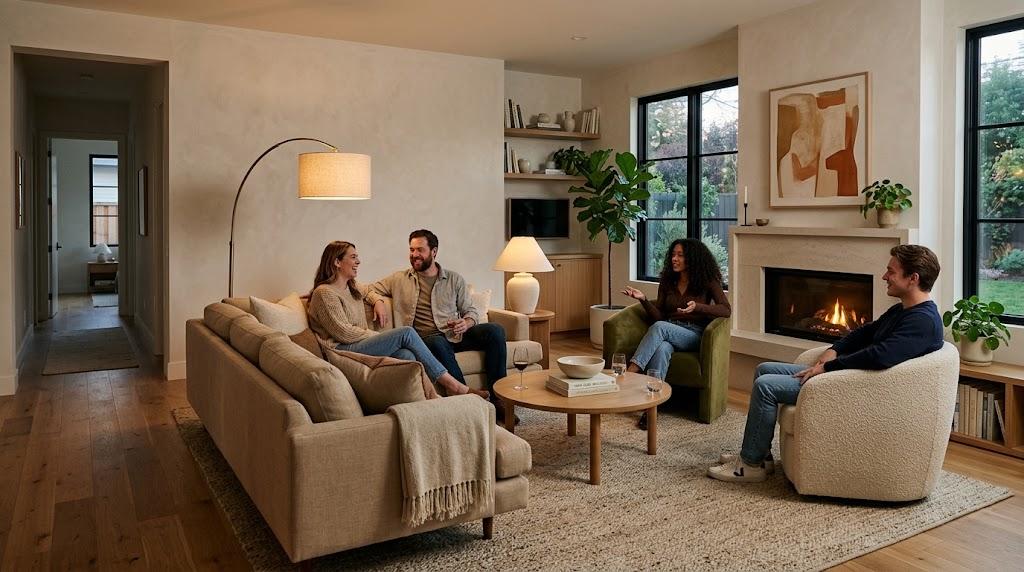
Think about the last time you attended a gathering that felt effortless. Chances are, nobody at that party complimented the furniture. But the furniture was doing its job — positioning people close enough to hear each other, oriented so that faces met faces, and arranged so that movement through the room felt natural. Now think about the last gathering that felt stiff and uncomfortable. The difference was almost certainly not the guest list. It was the floor plan.
How you place your furniture determines whether your living room becomes the place where people bond or the place where they endure each other. The following breakdown examines which spatial strategies shut down interaction and which ones unlock it.
The Setups That Build Walls Without Bricks
The Wide-Middle Mistake
It is tempting to push everything outward — sofas against long walls, armchairs flanking the corners, ottomans tucked beside bookshelves. This approach maximizes visible floor space and makes the room appear larger in photographs. But appearance and experience diverge here dramatically.
A room with all its furniture parked along the edges creates a social void at its center. Occupants end up spread across the room's perimeter like chess pieces arranged along the board's boundary. They strain to hear one another. They shout across the void. Nobody wants to be the first to cross the empty middle, so nobody does. The room looks big, but it functions like a hallway.
The Screen Monopoly
No one needs to apologize for owning a television. The device serves real purposes — entertainment, news, shared movies on a rainy evening. The problem arises when it becomes the room's undisputed ruler and every piece of furniture genuflects toward it.
In this arrangement, every occupant faces the same direction. Nobody faces anybody else. The room operates as a small theater, and the audience members are strangers who happen to share an address. A television can sit in a living room without dominating every conversation that happens there. It requires only a slight redistribution of the room's priorities.
The Congested Floor
Oversized furniture in a modest room produces a cascading series of problems. The coffee table crowds the sofa. The ottoman fills the gap between the armchair and the walkway. The side table pins the lamp against the wall. Every path from one seat to another requires some form of bodily negotiation.
When guests must twist, squeeze, or sidestep to reach a chair, they arrive at their seat already unsettled. That physical discomfort lingers as psychological discomfort. They perch on the edge rather than sinking in. They scan for the nearest exit rather than settling deeper into conversation. Generous circulation space is not a design luxury — it is the foundation upon which every other comfort is built.
The Visual Overload
Cluttered tabletops create a specific kind of anxiety that is difficult to articulate but easy to feel. When a coffee table is stacked high with magazines, mail, decorative objects, and remote controls, guests struggle to find a spot for their glass. They worry about disturbing your arrangement. They feel like intruders in a space that was not prepared for them.
Two or three thoughtfully chosen items on a table communicate something entirely different. A single candle, a small dish, and perhaps one book say that the surface was prepared with care. That openness translates into an emotional welcome. People breathe easier in rooms where surfaces breathe too.
The Setups That Turn Strangers Into Guests
Facing Each Other, Not the Wall
The single most effective change in any living room is repositioning furniture so that seats face each other rather than the walls. Pull a sofa into the center of the room. Place two chairs across from it. Angle everything inward so that eye contact requires no contortion.
Eight feet is a useful benchmark for the distance between opposing seats. At that range, voices carry without amplification, facial expressions remain visible, and personal space is respected. A room built around this kind of inward-facing cluster develops a warmth that no amount of wall-hugging furniture can replicate.
The Seat With a View of the Door
Most people do not consciously think about sightlines when they sit down. But the body registers orientation information constantly. A person seated with their back to the room's only entrance occupies that seat with a fraction of their attention diverted toward what they cannot see. The result is a subtle but persistent state of alertness that inhibits relaxation.
Turning primary seating toward the entry point resolves this without any visible design change. Many homeowners who seek a house feng shui consultation are surprised to learn that their chronic discomfort in the living room traces to this single spatial relationship. Practitioners who specialize in feng shui services consistently identify entrance visibility as one of the most impactful factors in how a room feels. The adjustment — sometimes as simple as rotating a sofa ninety degrees — can transform the emotional register of the entire space.
Rugs That Draw Boundaries
Open-concept architecture eliminates walls but also eliminates visual definition. When the living area bleeds without interruption into the kitchen and dining zone, people lack a clear signal about where the social gathering happens. They cluster near the kitchen island by default because no other zone announces itself.
A generously proportioned area rug corrects this by establishing a visible perimeter around the seating arrangement. The rug should be large enough that every seat's front legs rest upon it, binding the pieces into a unified whole. A rug that sits small and isolated beneath the coffee table, disconnected from the furniture around it, deepens the sense of fragmentation rather than resolving it.
Triangular Seating Beats Linear Seating
Sectional sofas offer efficient seating capacity, but their shape works against inclusive group dynamics. Five people in a row can only interact with their immediate neighbors. The person on one end has zero connection to the person on the other end. The sectional produces a lineup, not a gathering.
Splitting the sectional into two smaller pieces, or supplementing it with an accent chair pulled in at an angle, creates a triangular configuration. Triangles are the most inclusive shape for group conversation because every participant occupies a position from which they can see and hear every other participant. This geometric shift changes the texture of every interaction in the room.
The Luxury of Empty Space Between Pieces
Spacing between furniture is not wasted space — it is the medium through which comfort travels. A coffee table pressed against the sofa makes standing up from the couch an athletic event. A coffee table placed six feet away becomes purely decorative because nobody can reach their drink without standing.
The ideal gap between sofa and coffee table sits at approximately eighteen inches. Walkways require at least three feet of clearance. These measurements align with the dimensions of the moving human body — enough room to stand, turn, and walk without collision. When movement through a room requires no thought, the mind is free to focus on the person across from it.
Practical Steps You Can Take Tonight
You do not need to buy new furniture, hire a designer, or overhaul your budget to improve your living room. What you need is an hour, a clear plan, and the willingness to push heavy objects across the floor.
Start by removing everything. Clear the room down to its barest essentials. An empty space recalibrates your spatial thinking. You stop seeing the room as it currently is and start imagining what it could become.
Identify the room's strongest focal point. A fireplace provides a natural anchor — face your seating toward it. A large window with a view serves the same purpose. If neither feature exists, install a focal point of your own. A large piece of art, a substantial bookshelf, or a tall sculptural lamp can center the room's energy.
Move the primary seating inward. Float the sofa off the wall and into the room. Place a narrow console behind it with a lamp to anchor it visually. Add two chairs facing the sofa, and you have created a purposeful conversation zone — no construction required.
Reevaluate the lighting. A single overhead source produces the flat, unflattering quality of an office. Introduce layered light: a floor lamp at one end of the sofa, a table lamp at the other, and perhaps a pendant or a sconce for accent. Warm, varied illumination slows people down and softens their edges.
Handle the television with discretion. Place it behind doors or mount it on a secondary wall. When the screen is off, it should be invisible — part of the background rather than the room's defining feature. A mirror positioned on the opposite wall redirects attention toward natural light or art.
When personal adjustments feel insufficient, consulting a house feng shui consultation can reveal spatial dynamics that self-assessment misses. Trained practitioners see patterns — competing focal points, energy corridors that dead-end, corners that accumulate stagnation — that are invisible to the untrained eye. Even well-designed rooms benefit from this kind of expert spatial review.
Periodic engagement with feng shui services also helps homeowners maintain spatial awareness as their lives and needs evolve. A room that felt perfectly configured two years ago may require recalibration as family dynamics, daily routines, or even the objects within the space change over time.
What Matters in the End
A living room is a social machine. Its parts — chairs, tables, rugs, lamps — are not decorative accessories. They are functional components that either facilitate human connection or obstruct it. The difference between a room that brings people together and a room that drives them apart is not budget, taste, or style. It is intention.
Stand in your doorway and study your living room for three honest seconds. Ask yourself whether the space invites you to sit down or suggests you keep moving. If the answer disappoints you, start tonight. Shift the couch, pull in a chair, clear a tabletop, and watch what happens when your room begins working with you instead of against you.

 English
 Arabic
 French
 Spanish
 Portuguese
 Deutsch
 Turkish
 Dutch
Dutch
 Italiano
 Romaian
 Portuguese (Brazil)
 Greek
Greek