


The CSA Z768 Climate-Adaptation Revision: What's Coming for Phase I ESAs
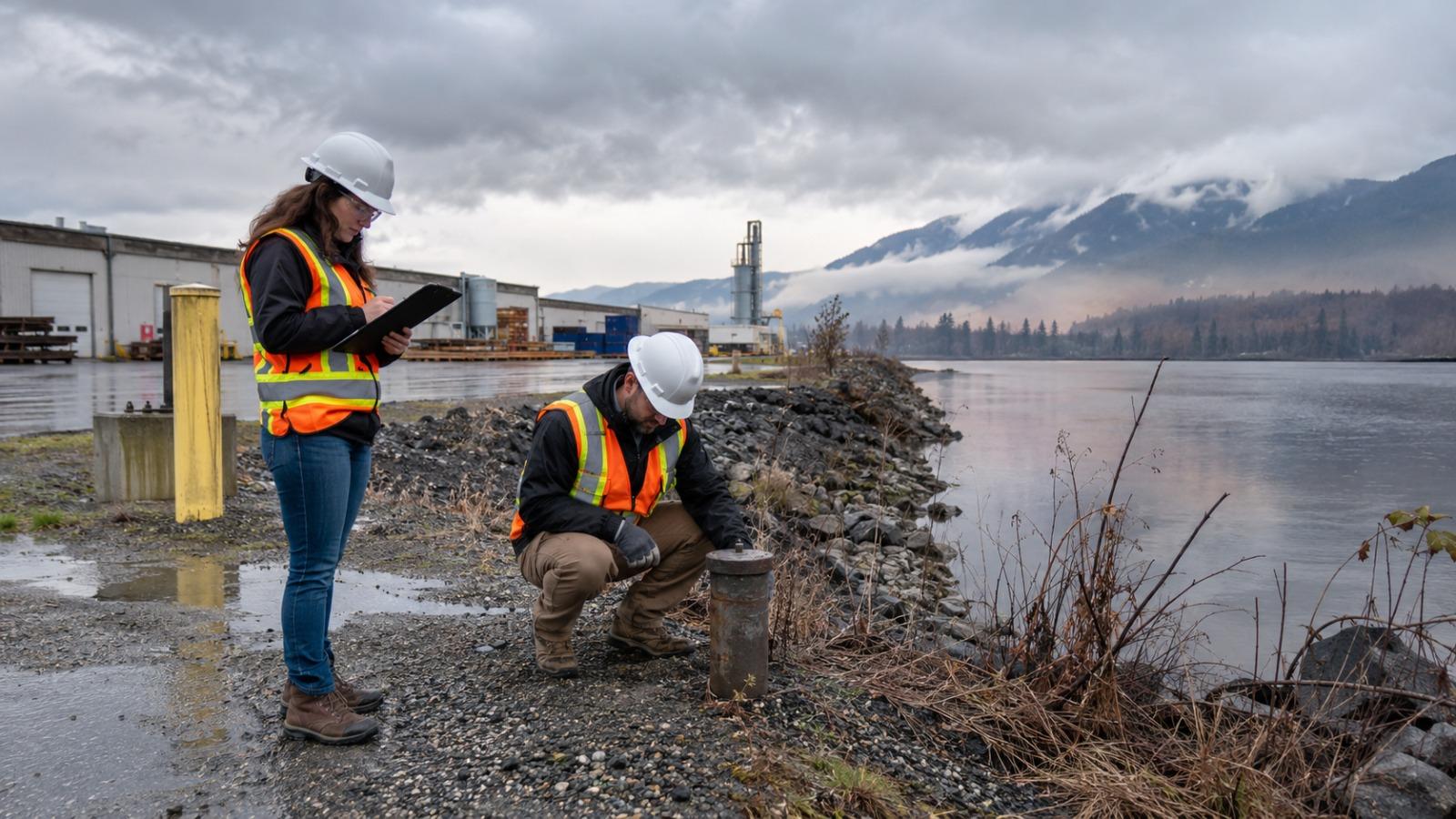
Every Phase I ESA we write looks backward. Historical aerial photos, old fire insurance maps, decades of prior land use, all of it is about reconstructing what happened on a site before today. What almost never gets asked, formally, is what is going to happen to that site over the next twenty or thirty years as the climate around it shifts. That gap is exactly what the Standards Council of Canada has now opened a file to close.
If you work anywhere near commercial real estate, lending, or environmental due diligence in Alberta, BC, Saskatchewan, or Manitoba, this is worth understanding now, not after it becomes a requirement.
What the Standards Council of Canada Actually Filed
On May 8, 2026, CSA Group submitted a formal Notice of Intent to the Standards Council of Canada for a new edition of CSA Z768, the national standard that governs Phase I Environmental Site Assessments. The public comment period ran from May 20 to June 10, 2026, and the project's status is currently listed as "proceeding to development." That means it has cleared the initial review stage but does not yet have a published text or a confirmed release date.
What is confirmed is the intent behind it. According to the filing, the new edition will integrate climate change adaptation considerations throughout the Phase I ESA process, incorporate forward-looking climate data and projections where appropriate, and give practitioners a formal way to flag climate-related risks that could affect site conditions, contaminant behaviour, and remediation outcomes over time.
What "Climate Adaptation" Will Actually Mean Inside a Phase I ESA
The filing is a scope document, not a finished standard, so the exact clause language isn't set yet. But it points to three concrete shifts in how an assessment gets built:
● Forward-looking data instead of purely historical data. Alongside the usual archival records review, assessors would be expected to weigh climate projections, not just past conditions, when evaluating a site
● Contaminant behaviour under changing conditions. A containment or risk-management plan built around today's water table or flood line can fail if that water table rises or that flood line moves, and the new edition is meant to force that question onto the table
● Lifecycle risk to infrastructure and remediation systems. Pump-and-treat systems, caps, and other long-term controls all depend on physical conditions staying roughly stable. A climate-adapted ESA would ask whether that assumption still holds for the site in question
Why This Actually Matters Across Alberta, BC, Saskatchewan, and Manitoba
This isn't an abstract policy exercise for Western Canada. The region has direct, recent experience with exactly the kind of risk this revision is aimed at:
● Alberta has already seen how a major flood event can change a floodplain's risk profile essentially overnight, and river-adjacent industrial and commercial sites across Calgary and southern Alberta still carry that exposure
● BC's wildfire seasons have repeatedly altered watershed behaviour and surface runoff patterns near previously stable sites, which is exactly the kind of shift a static, historical-only assessment misses
● Saskatchewan and Manitoba are seeing more variable groundwater recharge patterns tied to shifting precipitation, which matters directly for any site where a remediation plan assumes a stable water table
None of that requires a published standard to already be true. It just means the standard is catching up to conditions practitioners in this region have been managing informally for years.
What This Doesn't Change, Yet
It's worth being precise here, because it's easy to overstate a Notice of Intent. The current governing edition, CSA Z768-01 (R2022), remains fully in force. No lender, regulator, or insurer is going to reject a Phase I ESA today for not including forward-looking climate projections, because that requirement does not exist yet. "Proceeding to development" can still take a long time, and Notices of Intent do occasionally get revised, delayed, or narrowed in scope before a new edition is actually published.
The honest position for anyone reading this is: track it, don't panic about it. A Phase I ESA completed under the current standard today is not deficient. It just may need a supplemental climate screen added later if the new edition arrives while the report is still being relied on.
How to Prepare Now, Before the New Edition Lands
● Ask your consultant whether they are actively tracking the CSA Z768 Notice of Intent, not just aware that it exists
● For sites near floodplains, river valleys, or wildfire-interface zones, request a voluntary climate exposure note be added to the current report, even though it isn't mandatory yet
● If your remediation or risk-management plan relies on a stable water table or containment barrier, ask what happens to that plan under a higher-water or higher-runoff scenario
● Build a small time buffer into deals where financing depends on environmental sign-off, in case a new edition arrives mid-transaction and a lender's policy shifts to reference it
This is the kind of shift where getting ahead of it costs very little now and can save a genuine scramble later. Our Phase I and Phase II ESA team is tracking this Notice of Intent as it moves through development, and can fold a voluntary climate exposure review into a current assessment for sites where it genuinely matters.
Regulatory-currency disclaimer:
Standards development timelines shift. The information here reflects the Notice of Intent status as filed with the Standards Council of Canada; confirm the current status directly with CSA Group or the Standards Council of Canada before relying on this for a live transaction, since a published edition, once it exists, will supersede everything described above.
Frequently Asked Questions
Is the new CSA Z768 edition published yet?
No. As of the Standards Council of Canada's filing, the project status is "proceeding to development" following a public comment period that closed June 10, 2026. There is no published text and no confirmed release date yet.
Do I need to do anything differently for my Phase I ESA right now?
Not as a requirement. The current standard, CSA Z768-01 (R2022), still governs assessments and remains fully valid. Adding a voluntary climate exposure note is worth considering for flood-prone or wildfire-interface sites, but it is not mandatory.
Will this revision apply retroactively to Phase I ESAs already completed?
No. Standard revisions apply going forward from the date a new edition is published. An existing report stays valid under the standard it was completed against, though a lender or insurer could still request an updated assessment depending on their own policy.
What kinds of sites are most likely to be affected once the new edition takes effect?
Sites near floodplains, river valleys, coastal or wildfire-interface zones, and any site where a remediation or risk-management plan depends on a stable water table are the most likely candidates for closer scrutiny.
Where can I follow the progress of this CSA Z768 revision myself?
The Standards Council of Canada publishes and updates the Notice of Intent directly on its website, including status changes, comment periods, and eventual publication.

 English
 French
 Spanish
 Portuguese
 Deutsch
 Turkish
 Dutch
Dutch
 Italiano
 Russian
 Romaian
 Portuguese (Brazil)
 Greek
Greek