


How SHIJING Supports Large Format Tile Lifting Frame Applications
Moving heavy construction materials requires careful consideration of the surface rather than relying on size alone. A vacuum suction cup can create a temporary connection when its sealing pad meets a suitable surface, making this type of equipment useful for handling glass, stone slabs, tiles, metal sheets, and related materials. However, concrete and natural stone can present very different surface conditions, so anyone considering a Large Format Tile Lifting Frame or vacuum handling solution should first examine the material, finish, weight, and working environment. With practical handling equipment and professional guidance available through shijingtools, what conditions determine whether vacuum suction can actually support concrete or stone?
Surface Condition Comes First
Vacuum lifting depends on the formation of an effective seal between the pad and the workpiece. A smooth, clean, relatively non-porous surface is generally easier to seal than a rough or highly porous one. This distinction becomes important when comparing polished stone, finished slabs, rough concrete, and unfinished masonry.
Stone does not have one universal surface characteristic. Polished marble or granite can present a comparatively smooth face, while textured stone may contain irregular areas that interfere with sealing. Engineered slabs can also have different finishes depending on their production process. Before lifting, the operator should inspect the actual contact area rather than assuming that every stone product will behave in the same way.
Concrete requires even greater attention. A dense, smooth precast surface may offer conditions that differ substantially from freshly cast concrete, unfinished structural concrete, or a rough outdoor element. Dust and fine particles can also interfere with the contact area. Because vacuum equipment relies on a sealed interface, surface cleanliness and texture can influence whether the connection remains stable.
What Does a 200mm Cup Really Tell You?
The diameter of a suction cup describes its physical contact area, but it does not independently establish whether a material can be lifted safely. Holding performance also depends on vacuum level, sealing quality, surface characteristics, load distribution, equipment design, and the direction in which the force is applied.
A 200mm configuration may be useful for certain smooth material-handling tasks, yet the same dimension should not automatically be treated as suitable for every stone or concrete application. The actual rated capacity and manufacturer's operating instructions remain essential references.
SHIJING's product range includes different suction cup structures, including pressure-gauge, digital-display, automatic air-pump, and electrical air-pump configurations. These variations show why choosing handling equipment involves more than comparing pad diameter. The working method, monitoring arrangement, and material characteristics all have a role in equipment selection.
Stone Slabs Offer Several Possibilities
Large stone slabs are frequently encountered in kitchens, bathrooms, commercial interiors, wall coverings, furniture production, and architectural projects. When the slab has a compatible surface, vacuum equipment can provide a convenient temporary grip during movement and positioning.
The handling process can become particularly demanding when the slab is broad and difficult to hold around its edges. A suitable vacuum device allows the operator to establish contact on the face of the material, which can support controlled movement during installation.
This does not mean that every stone slab should be lifted with a vacuum cup. Rough finishes, open pores, deep textures, surface contamination, cracks, or unusual shapes can affect the seal. The operator should therefore inspect the contact zone before use and follow the manufacturer's instructions concerning capacity, surface compatibility, and operating conditions.
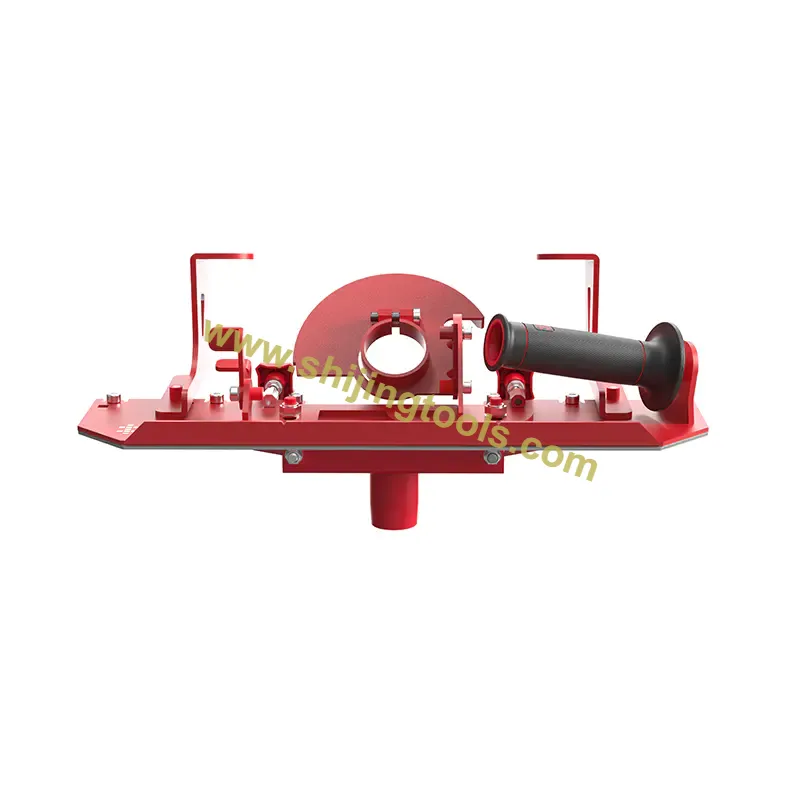
For large slabs, a coordinated frame can provide another approach. SHIJING describes its large format tile lifting frame as a tool designed for handling large tiles and slabs, with an adjustable frame structure intended to help workers move broad materials during construction, manufacturing, distribution, and renovation work.
Concrete Needs Careful Evaluation
Concrete is a different case because its surface can range from extremely smooth to highly textured. A finished concrete panel may present a relatively consistent face, while rough cast material can contain small irregularities, pores, dust, and surface particles.
For this reason, a suction cup should not be selected solely because the concrete appears visually flat. The actual sealing surface should be examined, cleaned when appropriate, and evaluated according to the manufacturer's requirements. If a reliable vacuum seal cannot be established and maintained, the lifting method should be reconsidered rather than forcing the equipment into an unsuitable application.
There is also an important distinction between temporary positioning and lifting a suspended load. A tool that works for controlled positioning against a surface should not automatically be treated as appropriate for overhead lifting. Working direction, movement speed, load distribution, and potential consequences of vacuum loss all need to be considered before operation.
Matching the Tool to the Job
Professional handling begins with matching equipment characteristics to the actual task. Operators should consider material weight, dimensions, surface finish, lifting orientation, travel distance, environmental conditions, and the number of contact points required.
For a large porcelain slab with a smooth face, a vacuum system may form part of a practical handling arrangement. For a rough concrete component, another gripping method may be necessary. A natural stone slab with a polished face can present different conditions from one with a textured finish, even when both pieces have similar dimensions.
SHIJING's wider product range reflects this task-based approach. Its website presents transport tools alongside cutting tools, measuring tools, leveling equipment, and installation products, creating a product environment centered on tile and construction work. The company also provides product information and industry articles covering suction equipment and large-format material handling.
Safe Handling Depends on Preparation
Before attaching a suction device, the contact area should be checked for dust, moisture, oil, loose particles, or other contaminants. The pad itself should also be inspected for visible damage or deformation. Once attached, the operator should verify the vacuum condition according to the equipment instructions before beginning movement.
The material should remain within the stated operating limits. If the vacuum indicator shows an unsuitable condition, the load should not be moved until the cause has been identified. Operators should also avoid assuming that a successful attachment on one surface guarantees identical performance on another.
For large format installation work, a lifting frame can provide a structured method of supporting broad tiles or slabs. SHIJING's published information notes that its frame is intended for different large-format handling situations, including construction sites, tile manufacturing environments, and renovation projects, with adjustable components designed around varying material dimensions.
For companies evaluating vacuum handling equipment, tile installation systems, or slab-moving solutions, shijingtools provides a dedicated range of professional paving and transport tools, while its published technical content helps users understand how different handling methods relate to actual working conditions. Companies considering a Large Format Tile Lifting Frame can review SHIJING's application information at https://www.shijingtools.com/, where the frame is discussed in relation to large tiles, stone slabs, construction work, manufacturing, and renovation projects.

 English
 Arabic
 Spanish
 Portuguese
 Deutsch
 Turkish
 Dutch
Dutch
 Italiano
 Russian
 Romaian
 Portuguese (Brazil)
 Greek
Greek