


Material and Sealing Design in Water Regulation
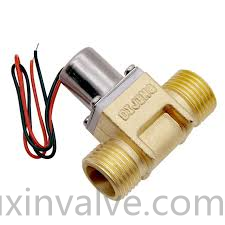
Modern automated taps combine sensing, electronic control, and hydraulic regulation in a compact installation. The Tap Solenoid Valve acts as the mechanical control point within this system, converting an electrical command into movement that opens or closes a water passage. Zhejiang Fuxin Electrical Technology Co., Ltd. focuses on electromagnetic design, material engineering, sealing structures, precision machining, and assembly control when developing valves for sanitary water-control equipment.
The electromagnetic actuator begins with the coil. When the control circuit supplies current, the coil creates a magnetic field that interacts with the magnetic core and armature. This produces movement that operates the internal valve mechanism. The response depends on the electrical properties of the coil, the magnetic characteristics of the core and armature, the air gap, and the mechanical resistance of the moving parts.
Consistent coil manufacturing is therefore important. Copper wire winding should maintain controlled positioning and tension, while insulation protects the conductor from electrical contact between turns. The bobbin supports the winding structure and helps maintain its position within the actuator assembly. Electrical testing can verify continuity and resistance, helping manufacturers identify deviations during production.
The magnetic circuit requires similarly controlled construction. Core and armature materials should provide suitable magnetic properties and stable dimensions. Their geometry determines how efficiently the magnetic field is concentrated and how much force is available for movement. Controlled machining and inspection of the magnetic components can help maintain the required dimensional relationship between the moving and stationary parts.
Mechanical guidance affects actuator stability as well. The armature needs to move through its guide with limited friction while maintaining appropriate positioning. Excessive clearance may permit unwanted lateral movement, whereas insufficient clearance can restrict actuation. Surface finish and dimensional accuracy therefore influence the interaction between electromagnetic force and mechanical movement.
The sealing system determines how this mechanical movement affects water flow. Depending on the valve structure, the actuator may control a diaphragm, plunger, gasket, or another sealing element. The selected material should provide suitable flexibility, compression recovery, and resistance to the intended water environment. The valve seat also requires a controlled surface so that the sealing component can establish consistent contact when the water passage is closed.
Internal hydraulic geometry is another important design factor. The inlet, outlet, orifice, and connecting passages determine how water travels through the valve. Engineers need to consider the relationship between these passages and the sealing structure to achieve appropriate flow behavior. The valve's performance also depends on the larger plumbing circuit, including the conditions on both sides of the component.
Automated taps commonly work with proximity or infrared sensing systems. The sensor detects a user, sends a signal to the controller, and causes the controller to activate the valve. This means that the valve must integrate with the electrical control architecture rather than functioning as an independent mechanical component. Electrical connection quality and consistent actuator response are important to this interaction.
Compact installation can influence the valve's structural design. The faucet body may provide limited room for the coil, valve body, connector, and water connections. Components must therefore be arranged efficiently while maintaining sufficient space for assembly and inspection. A compact structure should not compromise sealing alignment, armature movement, or electrical insulation.
Quality control can be distributed across the production process. Material inspection can verify incoming components, machining checks can monitor critical dimensions, and assembly inspection can confirm correct placement of seals and electromagnetic parts. Finished valves can be tested for electrical continuity, leakage, and functional actuation. These checks provide different forms of evidence that the assembled valve meets its intended design requirements.
For manufacturers integrating automated sanitary fixtures, choosing a Tap Solenoid Valve involves evaluating electromagnetic characteristics, sealing materials, hydraulic structure, electrical compatibility, installation space, and manufacturing consistency together. Zhejiang Fuxin Electrical Technology Co., Ltd. combines these factors in its sanitary water-control valve production, with related product information available at https://www.fuxinvalve.com/product/sanitary-ware-solenoid-valves/.

 English
 Arabic
 French
 Spanish
 Portuguese
 Turkish
 Dutch
Dutch
 Italiano
 Russian
 Romaian
 Portuguese (Brazil)
 Greek
Greek