


Play Therapy Activities for Kids: Techniques for Anxiety, Trauma & Emotional Regulation
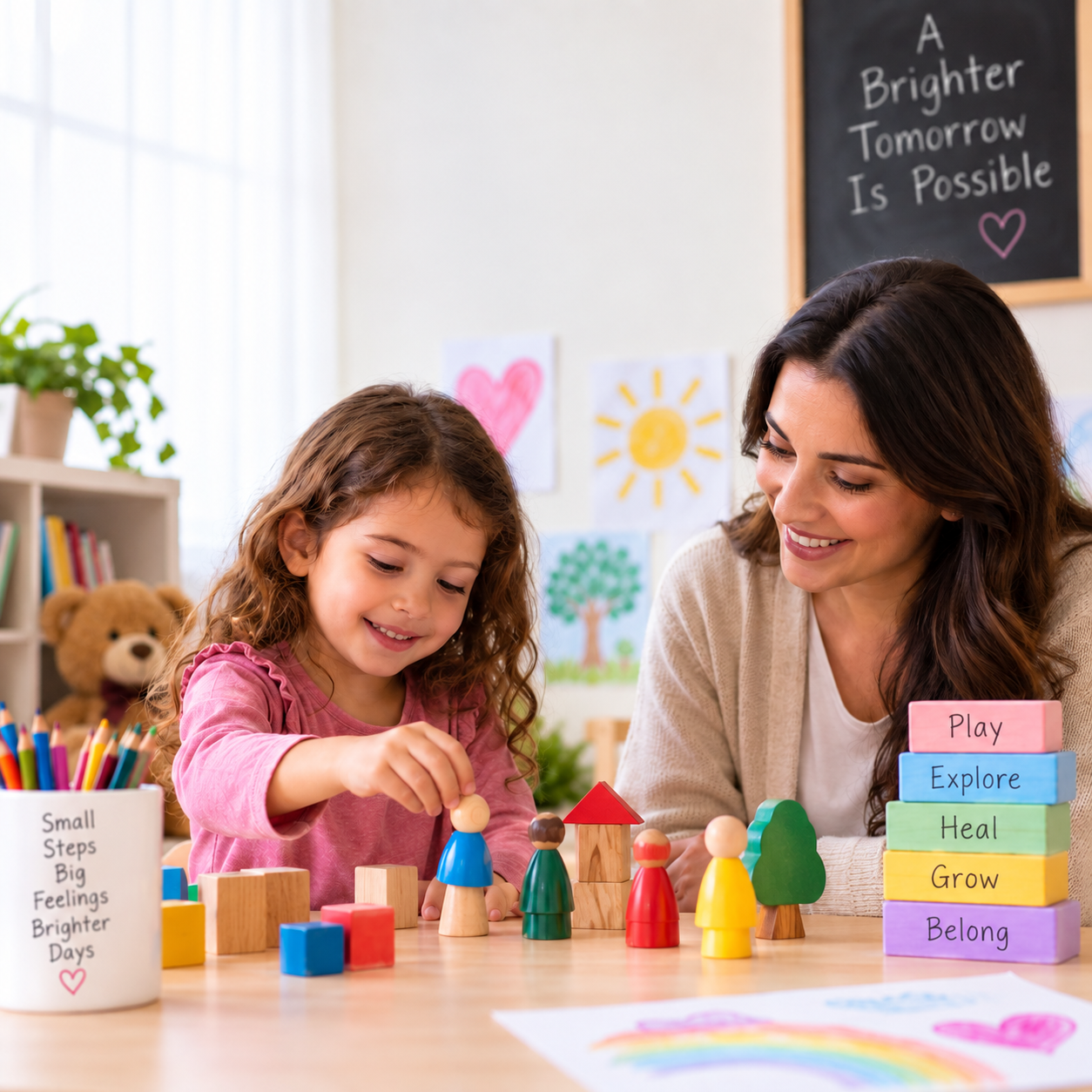
Children do not always have the words to explain what they are thinking or feeling. Anxiety, trauma, anger, family changes, social challenges, and other emotional difficulties can be difficult for children to communicate through traditional conversation. Play therapy activities for kids can provide developmentally appropriate ways to express emotions, explore experiences, practice coping skills, and build confidence in a therapeutic setting.
For mental health professionals, understanding play therapy techniques, play therapy activities, and common play therapy themes can support thoughtful and developmentally appropriate work with children.
What Is Play Therapy?
Play therapy is a therapeutic approach that uses play and play-based experiences as part of the therapeutic process with children.
Because play is a natural form of communication for many children, therapists may incorporate toys, games, storytelling, art materials, puppets, sand, role-play, and imaginative play into therapy.
Depending on the therapist's training and theoretical approach, play may be child-led, therapist-directed, or involve a combination of approaches.
The purpose of play therapy is not simply to entertain children. Therapeutic play activities are selected within a clinical framework based on the child's developmental level, presenting concerns, therapeutic goals, and individual needs.
Why Are Play Therapy Activities Helpful for Kids?
Children may find it difficult to explain complex emotions through conversation alone. Play can provide another developmentally appropriate form of communication and expression.
When clinically appropriate, play-based interventions may support children in:
-
Identifying and expressing emotions
-
Developing emotional awareness
-
Practicing coping strategies
-
Exploring social situations
-
Developing communication skills
-
Practicing problem-solving
-
Building confidence and self-esteem
-
Exploring relationships and boundaries
-
Expressing thoughts through creative activities
The appropriate activity will vary from child to child. Therapists should use professional judgment and appropriate training when selecting and applying interventions.
Play Therapy Activities for Kids With Anxiety
Anxiety can affect how children think, behave, communicate, and respond to everyday situations. Play-based activities can give therapists developmentally appropriate ways to explore worries and coping strategies.
1. Worry Drawing
Invite the child to draw what their worry looks like.
The therapist can use open-ended questions such as:
-
What does your worry look like?
-
When does your worry usually appear?
-
What makes the worry feel bigger?
-
What helps you feel more comfortable?
This activity can give children another way to communicate about anxiety without relying entirely on verbal explanations.
2. Feelings Charades
Create cards representing different emotions. The child chooses a card and acts out the emotion while another person guesses it.
This activity can encourage children to recognize emotional expressions and discuss situations connected to different feelings.
3. Coping Skills Toolbox
Help the child create a physical or imaginary toolbox containing strategies they can use when experiencing difficult emotions.
Possible coping strategies may include:
-
Deep breathing
-
Drawing
-
Taking a break
-
Talking with a trusted adult
-
Positive self-talk
-
Sensory activities
-
Listening to calming music
The therapist can help the child identify strategies that are appropriate for their needs and situation.
4. Therapeutic Storytelling
Create a fictional character who experiences a worry similar to the child's concern.
Ask the child to help decide:
-
What is the character worried about?
-
How does the character feel?
-
Who can help the character?
-
What could the character try?
Storytelling can create some distance from a difficult topic while providing opportunities to explore coping and problem-solving.
Play Therapy Activities for Trauma
Trauma-focused work requires appropriate clinical training and careful consideration of each child's circumstances. Play activities should not be used to pressure a child into discussing traumatic experiences before they are ready.
In an appropriately structured therapeutic setting, play-based interventions may be used to support emotional expression, coping, safety, and a sense of control.
1. Create a Safe Place
Invite the child to draw, build, or imagine a place where they feel safe and comfortable.
They might create the setting using:
-
Drawing materials
-
Blocks
-
Dolls or figures
-
Miniature objects
-
Art materials
The therapist can explore what makes the environment feel safe and what resources the child can identify.
2. Therapeutic Story Creation
The therapist and child can develop a fictional story involving a character who faces a difficult situation.
The child can help create the character's:
-
Feelings
-
Challenges
-
Support system
-
Coping strategies
-
Ending
This can provide a structured way to explore emotional experiences without requiring direct disclosure.
3. Building and Problem-Solving Play
Construction activities using blocks, building sets, or other materials can provide opportunities to practice planning, flexibility, persistence, and problem-solving.
Therapists should avoid assuming that every object or action represents a specific traumatic experience. Observations should be considered within the broader clinical context.
Play Therapy Activities for Emotional Regulation
Learning to recognize and manage emotions is an important developmental skill. Therapists can incorporate playful activities to help children notice emotions and practice different responses.
1. Emotion Thermometer
Create a visual scale that moves from calm to extremely upset.
Ask the child to identify:
-
How their body feels at different levels
-
What thoughts they notice
-
What situations move them up the scale
-
What strategies may help them move toward calm
2. Play-Dough Feelings
Invite the child to use play-dough to create faces representing different emotions.
The therapist can ask:
"What might make this character feel this way?"
This can encourage emotional identification and discussion.
3. Stop, Breathe, Choose
Turn emotional regulation into a simple game:
Stop → Breathe → Notice → Choose
The child practices pausing, identifying what is happening, and considering an appropriate response.
4. Emotion Scavenger Hunt
Place emotion cards around the therapy room. Ask the child to find a card and describe a situation in which someone might experience that emotion.
This can make emotional learning interactive and developmentally appropriate.
Play Therapy Activities for Social Skills
Play can create opportunities to practice communication, cooperation, boundaries, turn-taking, and problem-solving.
Therapists may incorporate activities such as:
-
Cooperative games
-
Turn-taking games
-
Puppet conversations
-
Role-play
-
Social stories
-
Problem-solving games
-
Team-building activities
For example, role-play can help a child practice asking for help, joining a group, responding to disagreement, or communicating a boundary.
Common Play Therapy Techniques
Different therapeutic approaches use different methods. Common play therapy techniques may include:
Child-Centered Play Therapy
Child-centered approaches generally provide children with opportunities to lead their play while the therapist offers an accepting and supportive therapeutic environment.
Directive Play Therapy
In directive approaches, the therapist may introduce or structure a particular activity around a therapeutic goal.
Examples may include emotion-identification games, therapeutic storytelling, role-play, or structured creative activities.
Therapeutic Storytelling
Stories and metaphors can provide children with developmentally accessible ways to explore feelings, relationships, challenges, and coping strategies.
Role-Play
Role-play allows children to practice possible responses to real-life situations in a therapeutic environment.
Creative and Expressive Play
Drawing, painting, clay, crafts, puppets, and other creative activities can provide additional ways for children to communicate and explore emotions.
Common Play Therapy Themes
Children may express recurring themes through play. However, therapists should be cautious about assigning one fixed meaning to an isolated behavior or play scenario.
Common play therapy themes may involve:
-
Safety and protection
-
Control and power
-
Family relationships
-
Separation and reunion
-
Conflict
-
Aggression
-
Nurturing and caregiving
-
Fear and danger
-
Loss and grief
-
Independence
-
Competence and mastery
Themes should be considered alongside the child's developmental stage, history, relationships, behavior, and overall clinical presentation.
How Do Therapists Choose the Right Play Therapy Activity?
There is no single play therapy activity that works for every child. Choosing an appropriate activity requires clinical judgment.

 English
 Arabic
 French
 Spanish
 Portuguese
 Deutsch
 Turkish
 Dutch
Dutch
 Italiano
 Russian
 Romaian
 Portuguese (Brazil)